
 Whatsapp
How to Find Your PAYE Reference Number: A Complete UK Guide
If you've been asked for your PAYE reference number and you're not sure where to look, you're not alone. It's one of the most commonly misplaced pieces of business documentation — partly because it looks similar to other HMRC numbers, and partly because it only really surfaces once a year or so, on correspondence most people don't keep to hand.
This guide explains exactly what a PAYE reference number is, what it looks like, where to find it, and — importantly — why it's not the same thing as your Accounts Office reference. Whether you're a new employer registering for the first time or a director trying to track down a number you've mislaid, this covers it.
If you are setting up payroll for a UK company, Leadforce can also help with PAYE registration and employer compliance, helping you understand the requirements and keep your payroll setup properly organised.
Quick Answer
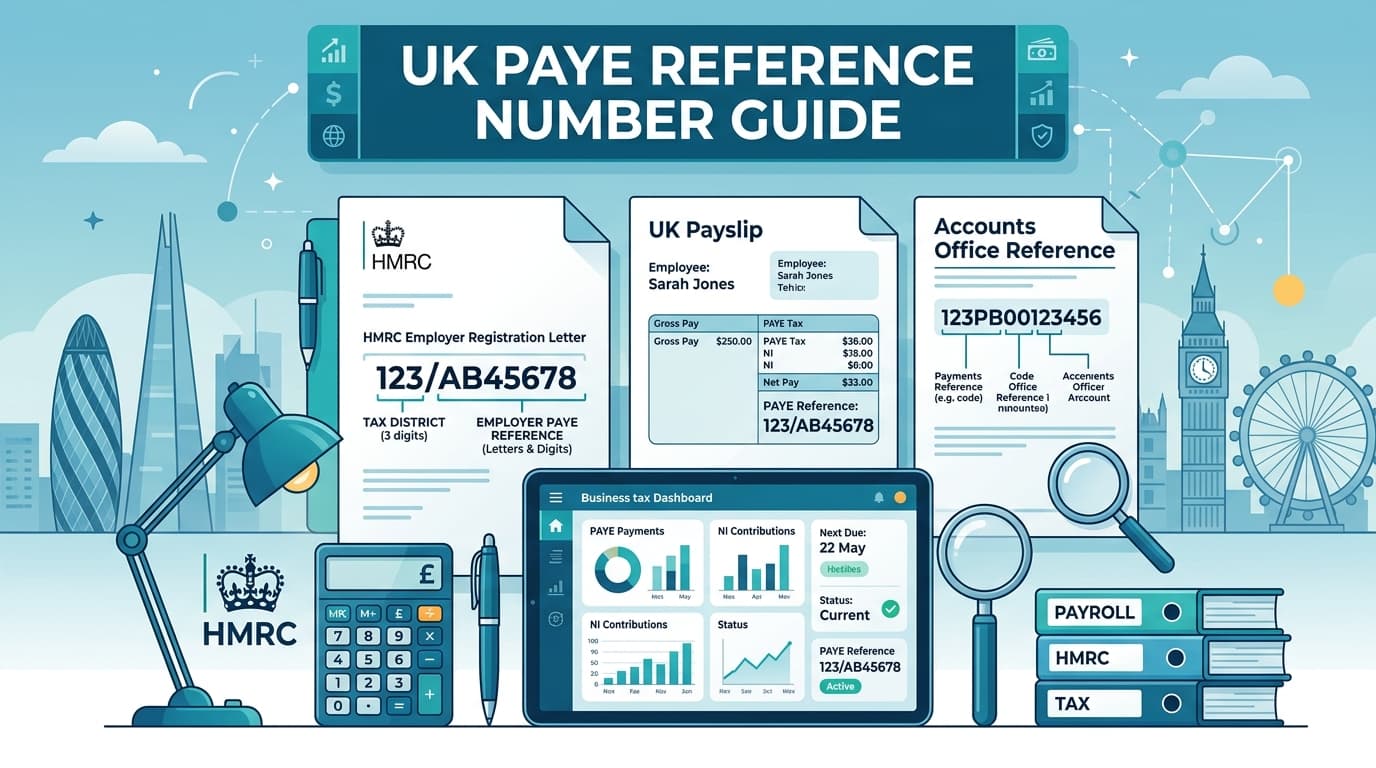
Your PAYE reference number (also called the employer PAYE reference) is a unique code HMRC issues when a business registers as an employer. It's typically formatted as three digits, a forward slash, then a mix of letters and numbers — for example, 123/AB45678. You'll find it on the HMRC letter confirming your PAYE registration, in your HMRC online (business tax) account, or on correspondence HMRC has sent about your payroll. It's different from your Accounts Office reference, which is used only for making payments.
PAYE Reference Number At A Glance
| Detail | Information |
|---|---|
| What it identifies | Your employer PAYE scheme |
| Issued by | HM Revenue & Customs (HMRC) |
| Who may have one | Employers registered for PAYE |
| Typical format | Numbers followed by a slash and an employer identifier (e.g. 123/AB45678) |
| Main use | Identifying your PAYE scheme for payroll and HMRC administration |
| Different from | UTR, Company Registration Number (CRN), and Accounts Office reference |
| Where to look first | HMRC PAYE registration correspondence and business tax account |
What Is a PAYE Reference Number?
A PAYE reference number — sometimes called an employer PAYE reference, Employer Reference Number (ERN), PAYE scheme number, or PAYE scheme reference — is the unique identifier HMRC assigns to an employer's Pay As You Earn scheme when a business registers to operate payroll.
It identifies the employer's scheme, not an individual employee. Every organisation running payroll — whether a limited company, sole trader with staff, partnership, or charity — is issued one when they register. If a business operates more than one PAYE scheme (for example, separate schemes for different divisions), each scheme has its own distinct reference.
You need this reference for:
Is a PAYE Reference Number the Same as an Employer Reference Number?
In most UK payroll contexts, the PAYE reference number is also referred to as the employer PAYE reference or employer reference number (ERN). It identifies the PAYE scheme that HMRC has assigned to an employer.
The terminology can be confusing because HMRC uses several different reference numbers for tax and payroll administration. Your PAYE reference should not be confused with your Accounts Office reference, Unique Taxpayer Reference (UTR), or Company Registration Number (CRN). Each serves a different purpose.
If you are unsure which reference a form, payroll provider, or HMRC service is asking for, check the wording carefully rather than assuming that another HMRC or company number is interchangeable.
PAYE Reference Number Format and Example
The employer PAYE reference generally follows this structure:
Standard UK PAYE Format
A typical example looks like 123/AB45678. The first three digits identify the HMRC tax office responsible for that PAYE scheme, and the characters after the forward slash identify your specific business or scheme within that office. Some older schemes, registered before 2001, may show a single letter after the slash rather than two — for example, 123/A45678.
You should always enter the reference exactly as issued, including the slash, when completing forms or payroll software fields. Getting the format wrong — or transposing it with your Accounts Office reference — is one of the most frequent causes of payroll and payment errors.
PAYE Reference Number vs Accounts Office Reference
This is where a lot of confusion happens, and it's worth being precise about, because the two numbers do different jobs.
| Feature | PAYE Reference Number | Accounts Office Reference |
|---|---|---|
| Purpose | Identifies your employer PAYE scheme | Tells HMRC where to allocate PAYE/NI payments |
| Format | Digits + slash + letters/numbers (e.g. 123/AB45678) | 13 characters, typically starting with a 3-digit code (e.g. 123PX00123456) |
| Used for | Payroll submissions, RTI, employer correspondence, tax forms | Making PAYE, National Insurance, and student loan payments to HMRC |
| Where issued | Same welcome letter, at registration | Same welcome letter, at registration |
| Common error | Using it as a payment reference | Using it in place of the PAYE reference on payroll forms |
Both numbers are issued together in the same registration letter, but they are not interchangeable. Using the wrong one when making a PAYE payment can result in the payment sitting unallocated with HMRC, even if the amount and timing are correct — which can cause unnecessary correspondence, and in some cases penalty notices, while the mismatch is resolved.
Rule of thumb: If you're only ever making payments to HMRC, you need the Accounts Office reference. If you're submitting payroll data, filing returns, or filling in employer-related forms, you need the PAYE reference.
Where to Find Your PAYE Reference Number
If you already have a live PAYE scheme, here are the most reliable places to check, roughly in order of usefulness:
Your HMRC registration letter
When you first register as an employer, HMRC posts a letter confirming your scheme, including your PAYE reference and Accounts Office reference together. This is the definitive source.
Your HMRC online (business tax) account
Sign in via GOV.UK using your Government Gateway credentials, then navigate to the PAYE for Employers section. Your employer PAYE reference is displayed alongside your scheme details.
HMRC correspondence about PAYE
Any subsequent letters, reminders, or penalty notices relating to your payroll scheme will usually carry the reference in the header or top right corner.
Your payroll software
If you or your accountant run payroll through commercial software (e.g. Xero, QuickBooks, Sage, BrightPay), the PAYE reference is normally stored in the employer setup and RTI configuration details.
Your accountant or payroll provider
If someone else manages payroll on your behalf, they will hold this reference on file and can provide it immediately upon request.
HMRC's Employer Helpline
As a last resort, HMRC can confirm the reference over the phone once they've verified your identity and business details.
Does It Appear on Payslips, P45s and P60s?
You'll often see this claimed as a straightforward fact, but it's worth being careful here. Payroll documents such as payslips, P45s and P60s may contain PAYE-related information, and many employers do choose to include the employer PAYE reference on these documents. However, this isn't guaranteed on every payslip format, and requirements can vary.
The safest approach is to treat payslips, P45s and P60s as a possible source of the reference, but always verify the exact number against your official HMRC registration letter or your HMRC online account if you're relying on it for something important — such as a tax form, a payment, or a payroll submission. Copying a reference incorrectly from a document that displays it inconsistently is a common source of avoidable errors.
How to Register for PAYE and Get a Reference Number
If you don't yet have a PAYE reference because you haven't registered as an employer, here's the general process:
1Establish that you need to register
You must register for PAYE before the first payday if you're paying anyone (including a director) at or above the National Insurance lower earnings limit, or if any employee already has another job or receives a pension.
2Register online via GOV.UK
Most limited companies and sole traders can register through the "Register as an employer" service on GOV.UK using their Government Gateway credentials.
3Register within the correct window
You can register up to two months before your first payday, but not earlier.
4Wait for HMRC to process the registration
Once processed, HMRC posts your PAYE reference number and Accounts Office reference together in a welcome letter.
5Store both references securely
Keep them in your business records and share them with your accountant or payroll provider, since you'll need them for every subsequent payroll submission.
Processing times can vary, so it's worth registering with a reasonable margin before your first payday rather than leaving it to the last moment.
What to Do If You've Lost Your PAYE Reference Number
If you've registered before but can't locate the reference, work through this checklist:
Avoid leaving a payroll submission or a payment until the last possible day if your reference is missing — resolving it can take time, particularly if HMRC needs to verify your identity by post.
Common Mistakes to Avoid
Confusing the PAYE reference with the Accounts Office reference
They look similar but serve completely different purposes.
Assuming it will always be on a payslip, P45 or P60
It may not be, depending on the format used by your payroll provider.
Mistyping the format
Omitting the slash or transposing digits can cause submission and RTI filing errors.
Using an old reference after restructuring
If your business has changed structure (for example, incorporating from a sole trader), you may have a new PAYE scheme and reference — check rather than assume the old one still applies.
Not keeping a written record
Relying on memory or a single document as your only source of the reference increases the risk of losing it.
Frequently Asked Questions
Is a PAYE reference number the same as a UTR?
No. A PAYE reference relates to an employer's PAYE scheme. A Unique Taxpayer Reference (UTR) relates to an individual's or company's Self Assessment or Corporation Tax record. They serve entirely different purposes and are issued separately.
Does every employer need a PAYE reference number?
Yes, if you're paying anyone above the relevant threshold, employing someone with another job, or paying a pension. Even a single-director limited company usually needs to register once the director takes a salary above the threshold.
Can I find my PAYE reference number online without paperwork?
Yes — your HMRC business tax account (accessed via GOV.UK with your Government Gateway login) will show your PAYE reference under your employer's PAYE scheme details.
What if my PAYE reference on a payslip looks different from HMRC's records?
Treat HMRC's own registration letter or your online account as the authoritative source, and query any discrepancy with your payroll provider.
Do I need a separate PAYE reference for each business I run?
Yes, generally. Each PAYE scheme has its own unique reference, so if you run more than one business or operate separate payroll schemes within one business, each will have a distinct number.
How long does it take to receive a PAYE reference number after registering?
This varies, but employers should expect a reasonable period after registration before the confirmation letter arrives by post. It's sensible to register well ahead of your first payday rather than relying on same-day turnaround.
Can my accountant register for PAYE on my behalf?
Yes, if they're authorised to act for your business with HMRC, an accountant or payroll agent can usually handle registration and manage the resulting references for you.
Can I find my PAYE reference number on Companies House?
No. Your PAYE reference is issued by HMRC and is separate from your Companies House company registration number. Companies House records do not replace your PAYE registration details.
Is the PAYE reference number the same as the employer reference number?
The terms are commonly used to refer to the employer's PAYE reference. However, you should check the exact wording of the form or service you are completing because HMRC uses several different reference numbers for different purposes.
What is the difference between a PAYE reference and a UTR?
A PAYE reference identifies an employer's PAYE scheme, while a Unique Taxpayer Reference (UTR) identifies a taxpayer's tax record. A company can therefore have both a UTR and a PAYE reference, and they should not be used interchangeably.
Where can I find my PAYE reference if I have just registered as an employer?
Check the PAYE registration confirmation or other HMRC correspondence issued after registration. You should keep the PAYE reference and Accounts Office reference with your business payroll records for future use.
How Leadforce Can Help
Getting PAYE registration and reference numbers right from the outset avoids a lot of downstream friction — misallocated payments, delayed submissions, and confused correspondence with HMRC. Leadforce works with UK company directors and business owners on the practical side of setting up and running compliant payroll, including PAYE registration, ongoing scheme management, and making sure the right references are used in the right places from day one.
If you're setting up a new company, taking on your first employee, or simply need clarity on how your PAYE and Accounts Office references fit together, the Leadforce team can help you get this right without the trial and error.
If you need guidance on registering for PAYE or managing your employer references, the Leadforce team can help you understand your options and the relevant requirements.