
 Whatsapp
UTR Number UK — Complete Guide
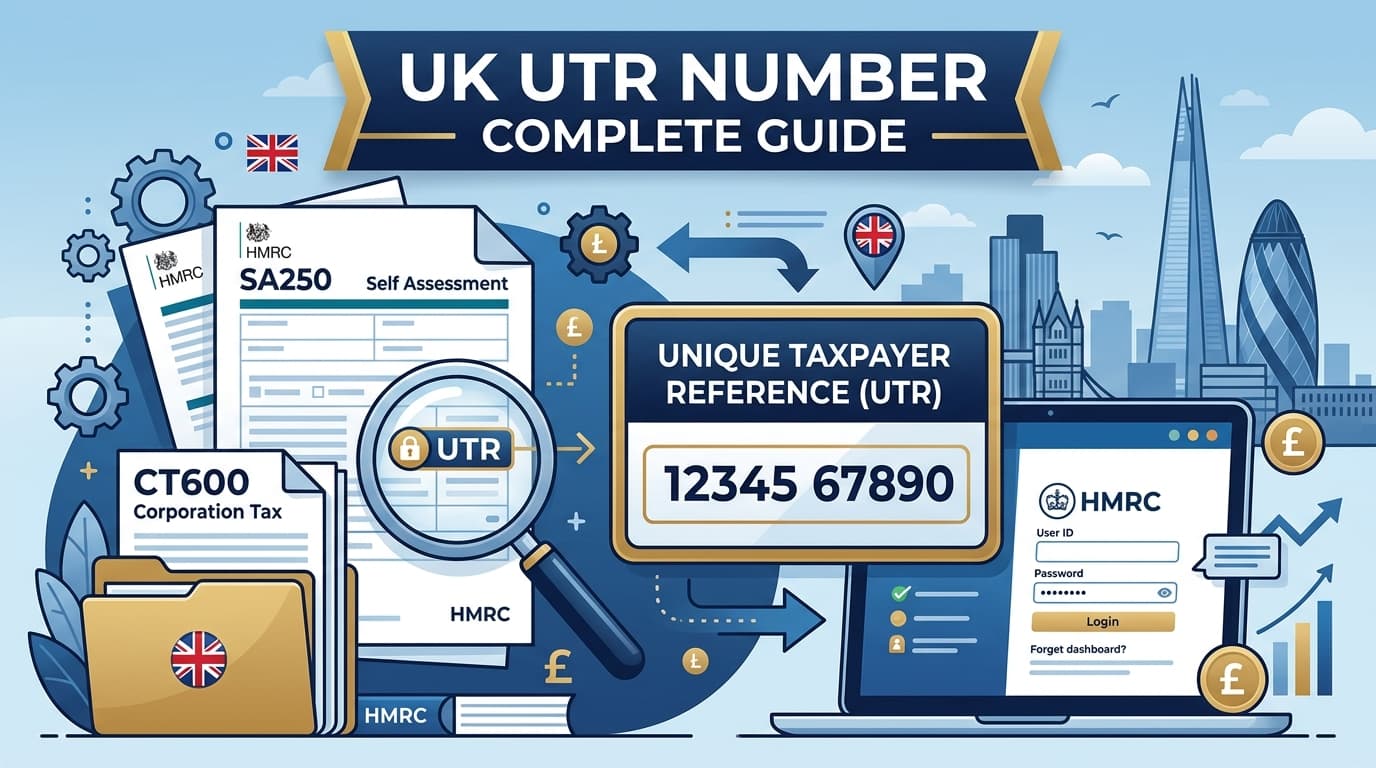
A UTR number (Unique Taxpayer Reference) is a 10-digit code issued by HMRC to identify you or your company for tax purposes. You need it to file Self Assessment or Corporation Tax returns, deal with HMRC, and work with accountants.
If you've lost your UTR, you can find it in your HMRC online account, on previous tax letters and returns, or by requesting a copy from HMRC.
In this guide, you'll learn exactly what a UTR number is, where to find yours (personal or company), how to get one if you don't have it yet, and what to do if it's gone missing—all in plain English, with practical steps you can use today.
Key Takeaways
- A UTR is a 10-digit number HMRC uses to identify you or your company for tax.
- You get it automatically when you register for Self Assessment or incorporate a limited company.
- Find it in your HMRC online account, on tax letters, or on previous returns.
- If lost, contact HMRC by phone or use the online recovery service.
- Keep it safe—losing it can lead to delays, identity risks, or filing errors.
What is a UTR Number?
A Unique Taxpayer Reference (UTR) is a 10-digit number that HMRC uses to identify you or your business in the UK tax system. Think of it as your tax fingerprint—it's unique to you or your company and stays the same for life.
You'll need your UTR to:
Without a valid UTR, your tax return won't be submitted correctly, which can lead to penalties or delays.
Personal UTR vs Company UTR
| Type | Who it's for | Used for | Where it appears |
|---|---|---|---|
| Personal UTR | Sole traders, partners, company directors | Self Assessment tax returns | SA250 letter, Self Assessment notices, personal tax account |
| Company UTR | Limited companies, partnerships, trusts | Corporation Tax returns (CT600) | CT41G "Welcome to Corporation Tax" letter, CT603 notices, Business Tax Account |
Both are 10 digits long, but they're separate references—directors have their own personal UTR in addition to their company's UTR.
How to Get a UTR Number
You don't apply for a UTR directly—HMRC issues it automatically when you register for the relevant tax.
For Sole Traders and Self-Employed Individuals
- Register for Self Assessment on GOV.UK (do this within 3 months of starting self-employment).
- HMRC will post your UTR to your registered address within 10–15 days (longer if you're overseas).
- You'll also receive an activation code to set up your online HMRC account.
You'll need:
- Your name, date of birth, and address
- National Insurance number
- Contact details (phone and email)
- Date you started self-employment
- Business address and type
For Limited Companies
When you incorporate a limited company:
- Companies House notifies HMRC automatically after incorporation.
- HMRC sends a CT41G letter ("Welcome to Corporation Tax") to your registered office within 14–15 days.
- This letter includes your company's 10-digit UTR.
You don't need to apply separately—your company UTR is issued automatically.
Where to Find Your UTR Number
If you've registered before, your UTR should be on record. Here's where to look:
For Individuals and Sole Traders
- HMRC Personal Tax Account – Log in at GOV.UK; UTR is in your Self Assessment summary
- HMRC App – Displayed on the main dashboard
- SA250 "Welcome to Self Assessment" letter
- Notices to file a tax return & payment reminders
- Previous Self Assessment tax returns – printed at the top
For Limited Companies
- CT41G letter – "Welcome to Corporation Tax" sent after incorporation
- CT603 notices – Notices to deliver a Company Tax Return
- Previous CT600 returns – Corporation Tax filings
- HMRC Business Tax Account – Corporation Tax enrolment view
- Correspondence from HMRC – Filing notices & statements
Pro tip: Search your email inbox for "UTR", "Unique Taxpayer Reference", or "Corporation Tax" to surface old HMRC messages and account confirmations quickly.
Lost UTR Number — What to Do
Don't panic if you can't find your UTR. Here's how to recover it:
1Step 1: Check All Your Documents
Go through the sources listed above—letters, tax returns, online accounts, and emails. Most people find their UTR in under 5 minutes by checking their HMRC online account first.
2Step 2: Contact HMRC
If you still can't locate it, contact HMRC directly:
For Self Assessment (Personal UTR)
Phone: 0300 200 3310 (Mon–Fri, 8am–6pm)
Online: Personal Tax Account reminder
Post: Self Assessment, HMRC, BX9 1AS
For Corporation Tax (Company UTR)
Phone: 0300 200 3410
Online: "Ask for a copy of your Corporation Tax UTR" service on GOV.UK
Posted to your company's registered office address
Have ready: Your National Insurance number (for personal UTR) or company name, CRN, and registered office address (for company UTR). HMRC can confirm your UTR verbally over the phone for security purposes.
3Step 3: Ask Your Accountant
If you work with an accountant or bookkeeper, they'll have your UTR on file—they need it to file your returns on your behalf.
UTR Number Lookup and Online Services
There's no public "UTR lookup" tool—you can only access your own UTR through verified HMRC channels.
Official options:
- Personal Tax Account (GOV.UK) – For sole traders and individuals
- Business Tax Account (GOV.UK) – For companies and partnerships
- HMRC App – Mobile access to your tax summary
- "Find your UTR" service – GOV.UK guidance and recovery links
Security Warning: Avoid third-party "UTR lookup" sites—they cannot access HMRC records and may be phishing attempts designed to steal your sensitive tax data.
Why Your UTR Matters for Compliance and Business Transactions
Your UTR isn't just for tax returns—it's a key identifier for:
Keeping your UTR safe and accessible reduces friction in these processes.
Frequently Asked Questions
What is a UTR number in the UK?
A UTR (Unique Taxpayer Reference) is a 10-digit number HMRC issues to identify individuals and businesses for tax purposes. You need it to file Self Assessment or Corporation Tax returns and to deal with HMRC about your tax affairs.
Where can I find my UTR number?
Check your HMRC Personal Tax Account or Business Tax Account online, the HMRC app, or previous HMRC letters and tax returns. Your UTR is printed on SA250 letters (personal) or CT41G/CT603 letters (company).
How do I get a UTR number if I don't have one?
Register for Self Assessment on GOV.UK (sole traders) or incorporate a limited company—HMRC will post your UTR within 10–15 days. You don't apply for it directly; it's issued automatically when you register for tax.
I've lost my UTR number—how do I get it back?
First, check your HMRC online account and old tax letters. If you still can't find it, call HMRC (0300 200 3310 for Self Assessment, 0300 200 3410 for Corporation Tax) or use the online "find your UTR" service.
What's the difference between a personal UTR and a company UTR?
A personal UTR is for Self Assessment (sole traders, directors), while a company UTR is for Corporation Tax (limited companies). Both are 10 digits, but they're separate—directors have both a personal UTR and their company has its own UTR.
How long does it take to receive a UTR number?
HMRC usually posts your UTR within 10–15 days after you register for Self Assessment or incorporate a company. It takes longer if you live overseas.
Do I need a UTR to file my tax return?
Yes. HMRC requires your UTR to process Self Assessment or Corporation Tax returns correctly. Filing without it can lead to errors, delays, or penalties.
Can I look up someone else's UTR number?
No. UTRs are confidential and only accessible to the taxpayer or their authorised agents (e.g., accountants). There's no public UTR lookup service.
What information do I need to register for a UTR?
You'll need your name, date of birth, address, National Insurance number, contact details, date you started self-employment, and business type. For companies, HMRC gets this from Companies House during incorporation.
Is a UTR the same as a Corporation Tax reference?
Yes—your company's UTR is its Corporation Tax reference number. It's the 10-digit code HMRC uses to identify your company for all Corporation Tax matters.
Need Help with Your UTR or Company Tax Affairs?
At Leadforce, we help UK SMEs and founders navigate company formation, tax compliance, and business transactions with confidence.
Whether you're setting up a new limited company, need to recover a lost UTR, or are preparing to sell your company, our team can guide you through the process end-to-end.