
 Whatsapp
What Are the Benefits of Working With a VAT Registered Company?
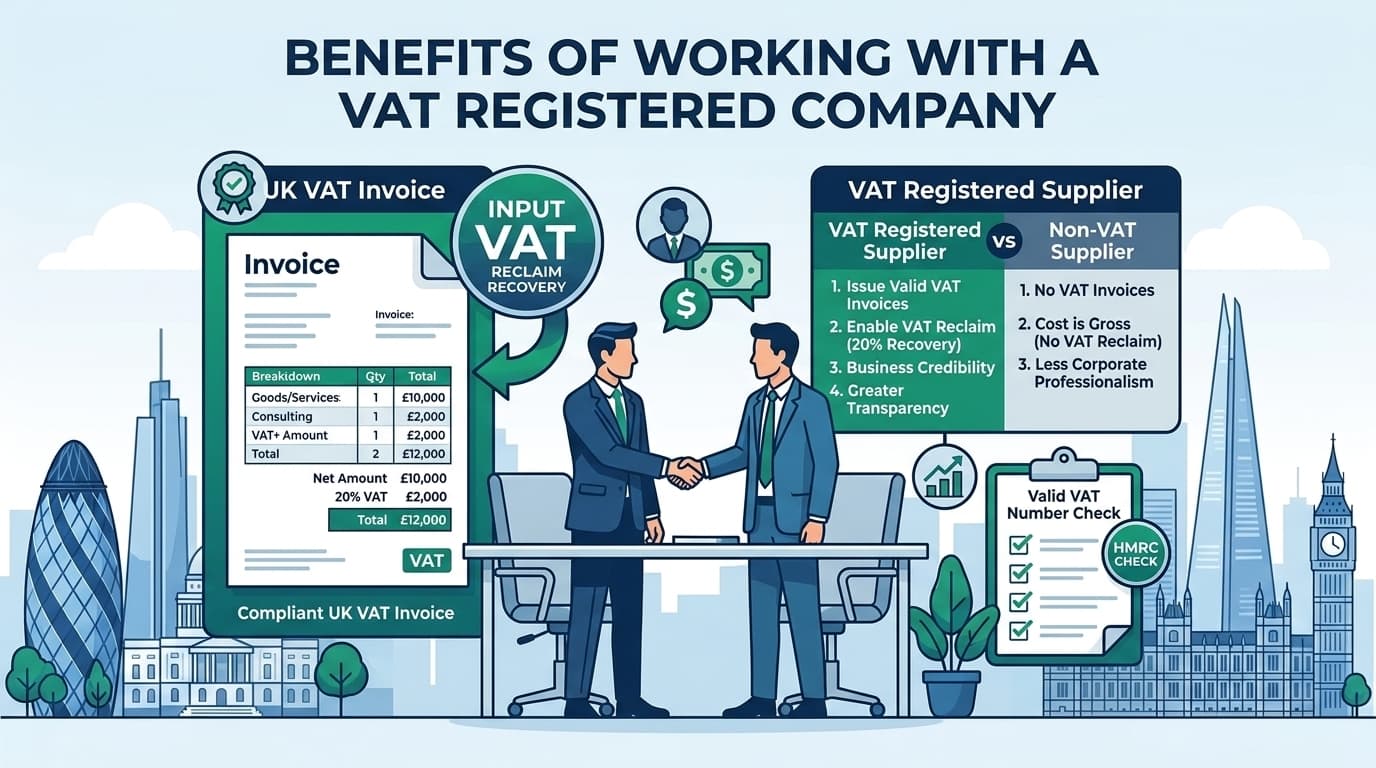
If you are choosing a supplier or considering buying an existing UK company, you may wonder whether VAT registration makes a practical difference. For many B2B transactions, it can — particularly where the buyer is VAT registered and eligible to recover input VAT.
If you are considering a VAT Registered Company that is already set up in the UK, VAT status can be one useful factor to consider alongside the company's wider corporate and compliance position.
However, VAT registration does not automatically mean a company is more established, reliable or financially stronger. The actual benefit depends on the buyer's VAT position, the type of purchase and whether the VAT charged is recoverable.
Quick Answer
The main benefits of working with a VAT registered company are:
- Potential input VAT recovery for eligible VAT registered buyers
- VAT invoices and clearer transaction records
- Easier VAT accounting and reconciliation
- Relevance to certain B2B and international transactions
- Ability to meet some commercial or procurement requirements
The key question is not simply whether the supplier is VAT registered. It is whether your business can recover the VAT charged on the particular purchase.
VAT registration also does not prove trading history, financial strength, creditworthiness or reliability.
What Does It Mean to Work With a VAT Registered Company?
A VAT registered company is registered with HM Revenue & Customs (HMRC) for Value Added Tax. Where applicable, it charges VAT on taxable supplies and has VAT accounting, record-keeping and reporting obligations.
In the UK, a business generally has to register when its taxable turnover exceeds £90,000 in a rolling 12-month period, or when it expects its taxable turnover to exceed £90,000 in the next 30 days. Businesses below the threshold can also register voluntarily. The current deregistration threshold is £88,000.
VAT registration tells you about a company's tax status. It does not tell you how long the company has traded, how much revenue it generates or whether it is financially strong.
How VAT Works in a B2B Transaction
A VAT registered business generally charges output VAT on taxable sales and pays input VAT on eligible business purchases.
On its VAT return, it accounts for the VAT it has charged and, where eligible, deducts recoverable input VAT. The resulting amount is generally paid to HMRC or, where appropriate, repaid.
Simple Example: Invoice Breakdown
A VAT registered supplier provides services for:
| Item | Amount |
|---|---|
| Net service fee | £10,000 |
| VAT at 20% | £2,000 |
| Total invoice | £12,000 |
If the buyer is VAT registered and eligible to recover the £2,000, its effective cost may be £10,000 after VAT recovery.
However, recovery is not automatic. It depends on the purchase, the buyer's VAT position and the required evidence. HMRC requires appropriate documentary evidence to support input tax claims.
7 Benefits of Working With a VAT Registered Company
1Potential Input VAT Recovery
This is often the main financial benefit for a VAT registered business. Where a purchase qualifies, a VAT registered buyer may be able to recover VAT charged by its supplier, reducing the effective cost of business purchases.
A valid VAT invoice is normally important evidence for an input VAT claim. Note that restrictions can apply to particular expenses, and businesses with exempt activities may have limited recovery.
2VAT Invoices and Clearer Records
A VAT registered supplier can issue VAT invoices for taxable supplies where required, showing the supplier name, address, VAT registration number, date, rate, breakdown, and totals.
This gives the buyer useful documentation for VAT accounting, bookkeeping and, where eligible, input VAT recovery.
3Easier B2B Accounting
When a VAT registered supplier clearly separates the net amount and VAT on its invoice, the buyer's finance team can more easily record the purchase and identify the VAT element. This is particularly useful for businesses processing a high volume of supplier invoices.
4Easier VAT Reconciliation
Clear VAT information can help businesses reconcile purchase records and prepare their VAT returns. For the buyer, the practical advantage is mainly having clearer transaction documentation that can be matched to accounting records.
5Useful for Businesses Making Taxable Supplies
If your business makes taxable supplies, you may be able to recover VAT on qualifying business purchases like equipment, technology, professional services, and infrastructure.
For example, if a business buys equipment for £50,000 plus £10,000 VAT and is entitled to recover the full £10,000, the VAT-inclusive price does not represent the final economic cost.
6Relevant to Certain International Transactions
VAT registration can also be relevant when businesses trade internationally. Rules concerning place of supply, reverse charge, import VAT, postponed VAT accounting, and foreign VAT recovery may apply depending on the countries involved.
7Can Meet Certain Procurement Requirements
Some corporate tenders or commercial contracts require particular VAT documentation or supplier tax identifiers. A VAT registered supplier can generally provide the relevant VAT documentation where applicable.
VAT Registered vs Non-VAT Registered Suppliers
The practical difference depends on the buyer:
| Feature | VAT Registered Supplier | Non-VAT Registered Supplier |
|---|---|---|
| Charges VAT where applicable | Yes | No |
| Can issue VAT invoices | Yes, where applicable | No |
| VAT recoverable by eligible buyer | Potentially | No VAT charged |
| Effect on non-VAT registered buyer | VAT may form part of cost | No VAT charged |
| Indicates company size or age | No | No |
Compare Net Cost, Not Just the Invoice Total
VAT registered supplier:
£10,000 + £2,000 VAT = £12,000 invoice.
Effective cost after full recovery: £10,000
Non-VAT registered supplier:
£11,000 with no VAT.
Effective cost (no VAT to reclaim): £11,000
Therefore, businesses should compare the effective cost after eligible VAT recovery, rather than simply comparing invoice totals.
Is a VAT Registered Company Always Better?
No.
For a VAT registered business making taxable supplies, a VAT registered supplier can be commercially convenient because eligible VAT may be recoverable.
For a non-VAT registered buyer or a business with restricted VAT recovery, VAT can instead become part of the cost.
When VAT charged by a supplier becomes a real cost:
- • Non-VAT registered businesses: cannot recover VAT through a VAT return.
- • Consumers: cannot recover VAT on personal purchases.
- • Businesses making exempt supplies: recovery is restricted.
- • Restricted expenses: specific VAT recovery limits apply.
- • Partially exempt businesses: only a portion of input VAT is recoverable.
What VAT Registration Does Not Guarantee
VAT registration is a tax status, not a quality rating.
| VAT Registration Does Not Guarantee | Why |
|---|---|
| Trading history | VAT registration does not prove substantial trading activity. |
| Customers or contracts | A VAT number does not establish a customer base. |
| Revenue | Businesses can register voluntarily below the threshold. |
| Banking access | Banks conduct their own KYC, AML and risk checks. |
| Creditworthiness | Lenders and suppliers perform separate assessments. |
| Reliability | VAT status does not remove commercial risk. |
| Cheaper prices | The result depends on the buyer's ability to recover VAT. |
What Should You Check Before Working With a VAT Registered Company?
VAT Checks
- • Verify VAT number on GOV.UK
- • Check details against invoice
- • Review required invoice elements
Company Checks
- • Incorporation date
- • Directors & PSCs
- • Accounts & confirmation statements
- • Charges & insolvency status
Commercial Checks
- • Trading history
- • Insurance & licences
- • Credit information
- • Contract & payment terms
Can You Buy an Existing UK VAT Registered Company?
An existing UK company can, in principle, be acquired through a share transaction. Some buyers consider this option because the company already has an existing corporate structure and may already be VAT registered.
However, the buyer should conduct proper due diligence before completing the transaction, reviewing VAT position, liabilities, accounts, filings, contracts and compliance history.
HMRC VAT Registration Transfer (Form VAT68):
HMRC provides a specific process for transferring a VAT registration when buying a business. Where the buyer and seller want to transfer the existing VAT registration number, both parties generally need to complete form VAT68, and the buyer must register for VAT as the new owner.
This means buyers should not simply assume that purchasing a company means its VAT registration can be used without completing the relevant HMRC process.
Considering an Existing UK VAT Registered Company?
Leadforce can help you understand the available options, due diligence checks, and transfer procedures before proceeding.
Frequently Asked Questions
What Are the Main Benefits of Working With a VAT Registered Company?
The main benefits are appropriate VAT invoices, potential input VAT recovery for eligible buyers and clearer VAT accounting. The actual benefit depends on the buyer's VAT position and the type of purchase.
Can I Reclaim VAT From a VAT Registered Supplier?
You may be able to recover VAT if you are VAT registered, the purchase qualifies and you have the required evidence. VAT recovery is subject to the applicable rules.
Is It Cheaper to Buy From a VAT Registered Company?
Not necessarily. A VAT registered buyer may recover eligible VAT, while a non-VAT registered buyer generally cannot. Compare the effective cost rather than just the VAT-inclusive price.
Does VAT Registration Mean a Company Has a Trading History?
No. VAT registration does not prove how long a company has traded or how much business it conducts.
Does a VAT Number Guarantee a Business Bank Account?
No. Banks and financial institutions conduct their own KYC, AML, identity and risk assessments.
Are All UK Businesses Required to Be VAT Registered?
No. The compulsory registration threshold for taxable turnover is currently £90,000, while businesses below that level can generally choose voluntary registration, subject to the relevant rules.
How Can I Check a Supplier's VAT Number?
Use the relevant official GOV.UK/HMRC checking service and compare the details with the supplier's information.
Can I Buy an Existing UK VAT Registered Company?
Yes, in principle. However, the company's VAT position, liabilities, filings and wider history should be reviewed, and any VAT registration transfer should follow the applicable HMRC process.
Conclusion
Working with a VAT registered company can provide practical advantages, particularly for VAT registered B2B buyers that are eligible to recover input VAT.
The main benefits are VAT invoicing, potential input VAT recovery and clearer VAT accounting.
However, VAT registration is not proof of business quality, trading history, financial strength or reliability. Whether a VAT registered supplier or existing VAT registered company is right for you depends on your own VAT position and wider commercial requirements.
For that reason, VAT status should always be considered alongside proper supplier or company due diligence.