
 Whatsapp
What Are the Benefits of Voluntary VAT Registration for Small Businesses?
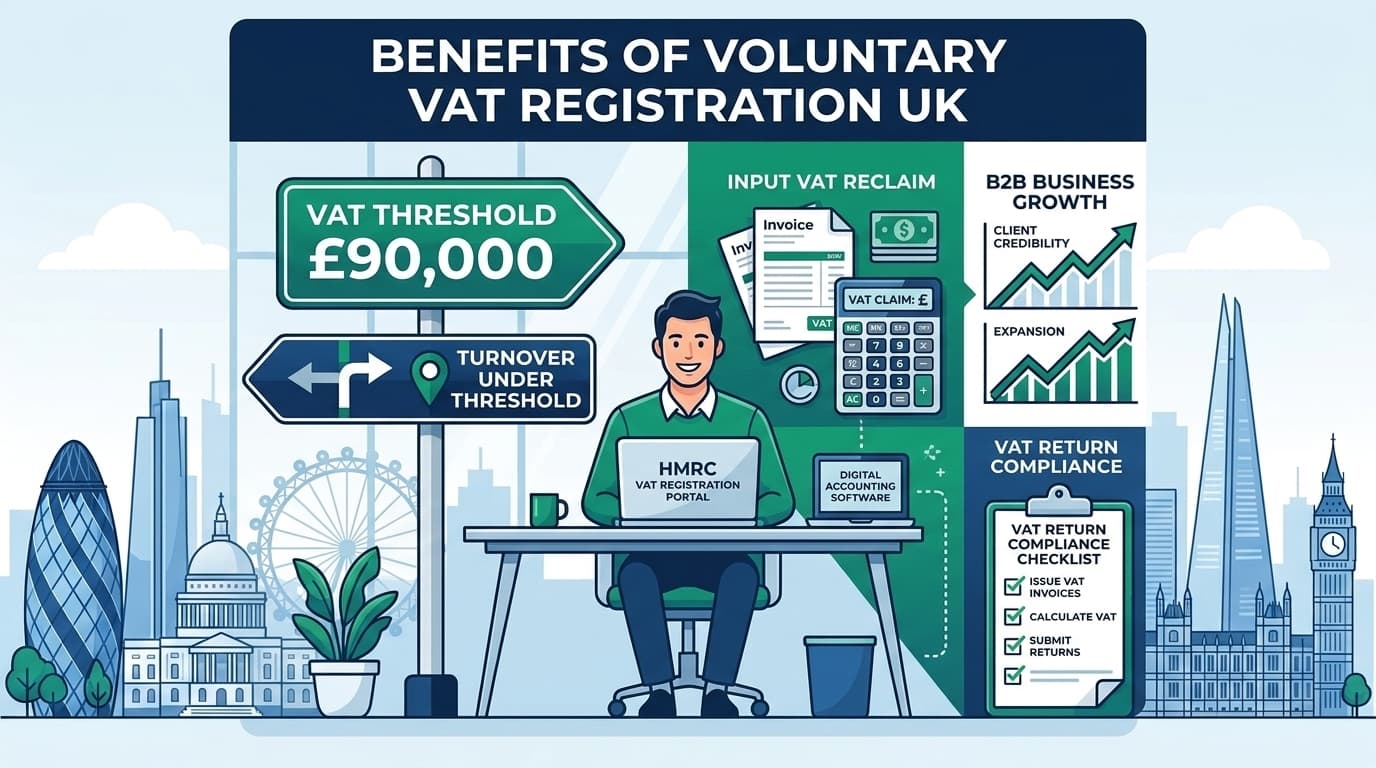
If your UK business has a taxable turnover below £90,000, you do not normally have to register for VAT yet. But that does not necessarily mean you should wait.
For some small businesses, voluntary VAT registration can make commercial sense. It may allow you to recover eligible VAT on business expenses, work more easily with VAT-registered customers and prepare for future growth.
For others, registering early can create unnecessary administration and make prices less competitive, particularly if most customers are consumers.
So the real question is not simply “Can I register for VAT below the threshold?”
It is: “Would voluntary VAT registration actually benefit my business?”
This guide explains the main benefits of voluntary VAT registration for small businesses, the potential disadvantages, and how to decide whether registering early is right for you.
Quick Answer
Yes. A UK business can generally register for VAT voluntarily even when its taxable turnover is below the mandatory registration threshold.
The main potential benefits include:
- Recovering eligible VAT on business purchases and expenses
- Potentially reclaiming certain VAT paid before registration, subject to HMRC conditions
- Making it easier to work with VAT-registered B2B customers
- Preparing your business for future growth
- Improving visibility over VAT costs and recovery
- Accessing VAT accounting schemes where the business meets the relevant conditions
However, voluntary VAT registration also means charging VAT on taxable sales, keeping additional records and submitting VAT Returns.
Whether it is worthwhile depends heavily on your customers, pricing model, expenses, business structure and growth plans.
Can You Register for VAT Below the £90,000 Threshold?
Yes.
The current UK VAT registration threshold is £90,000 of taxable turnover. A business does not have to wait until it reaches that figure to register voluntarily.
The threshold applies to taxable turnover rather than profit. Taxable turnover can include standard-rated, reduced-rated and zero-rated supplies, while VAT-exempt and certain out-of-scope supplies are treated differently.
The £90,000 threshold has applied since 1 April 2024 and remains the relevant threshold for 2026/27. The current deregistration threshold is £88,000.
For example, a consultancy generating £55,000 of taxable turnover may choose to register voluntarily if the commercial benefits outweigh the additional VAT administration. A business with £55,000 of sales to consumers may reach a very different conclusion.
That is why turnover alone should not determine the decision.
The Main Benefits of Voluntary VAT Registration
1You May Be Able to Reclaim VAT on Eligible Business Expenses
One of the biggest reasons small businesses consider voluntary VAT registration is input VAT recovery.
Once registered, a business may be able to recover eligible VAT paid on qualifying business purchases and expenses through its VAT Return, subject to the normal VAT recovery rules.
Examples can include eligible VAT on:
Not every expense qualifies for full recovery. Some costs are restricted, partially recoverable or excluded depending on the circumstances.
If reclaiming eligible input VAT is one of your main reasons for registering, it is worth reviewing your expenses before making the decision.
Businesses that are already VAT registered and need help identifying eligible input VAT can also explore Leadforce's VAT Reclaim UK service.
2You May Be Able to Recover Certain VAT Paid Before Registration
Voluntary registration can also be relevant if you have already incurred substantial business expenses before registering.
Subject to HMRC's conditions, VAT-registered businesses may be able to reclaim certain VAT incurred before registration.
Broadly, the rules can allow recovery for:
There are conditions around how the goods or services were used, whether they are still held or relevant to the business, and whether the VAT can legitimately be recovered.
Therefore, do not assume that every VAT invoice from before registration can simply be added to your first VAT Return. A proper review is important, particularly if your business has significant pre-registration expenditure.
3VAT-Registered Customers May Find Your Pricing Easier to Work With
For a B2B business, your customer base matters.
If most of your customers are themselves VAT registered and making taxable supplies, they may generally be able to recover eligible VAT charged to them.
That can make voluntary registration less commercially difficult than it would be for a business selling mainly to consumers.
This means customer type is one of the most important factors when deciding whether to register voluntarily.
4It Can Make the Transition to Future Growth Smoother
A business that is growing towards the VAT threshold may decide to register before it becomes mandatory.
Doing so can give the business time to establish:
This can reduce the pressure of trying to introduce VAT systems while the business is simultaneously dealing with rapid sales growth.
However, voluntary registration should not be treated as automatically better simply because you expect turnover to increase. The timing still needs to make commercial sense.
5It Can Help When Your Business Has Significant VAT-Bearing Costs
Some businesses have relatively low turnover but significant taxable business expenditure.
For example, consider a small product business that is investing heavily in:
- Equipment
- Stock
- Professional services
- Packaging
- Business premises
- Technology
If a meaningful proportion of those costs includes recoverable VAT, voluntary registration may make the VAT position more attractive.
The important point is to compare the potential recoverable VAT with the additional administration and the effect of charging VAT on your sales.
6You May Be Able to Use Certain VAT Accounting Schemes
VAT registration can also make a business eligible to consider certain VAT accounting schemes, provided it meets the relevant conditions.
Depending on the business and its circumstances, this can include schemes such as:
Cash Accounting Scheme
Pay VAT when customers pay you, aiding cash flow.
Annual Accounting Scheme
Submit one VAT return annually with interim payments.
Flat Rate Scheme
Pay a fixed percentage of turnover to HMRC.
These schemes have different eligibility rules and commercial implications. They should not be treated as automatic benefits of registration. A business should assess whether a particular scheme actually suits its margins, customers, transaction profile and administrative requirements.
How Much Could Voluntary VAT Registration Save?
This is where many businesses make the wrong calculation.
Suppose a small consultancy has:
- £60,000 annual taxable sales
- £12,000 of qualifying business costs
- £2,400 VAT included in those costs
At first glance, the ability to recover £2,400 of eligible input VAT may look like a strong reason to register.
That is not automatically a £2,400 net saving.
The business must also consider:
- • VAT that would need to be charged on taxable sales
- • Whether customers can recover the VAT
- • Whether prices would need to change
- • Additional administration
- • Accounting costs
- • Cash-flow implications
- • Whether all input VAT is actually recoverable
The right calculation is therefore not:
“How much VAT can I reclaim?”
It is:
“What is the overall commercial effect of registering for VAT?”
That calculation can be very different for a B2B consultancy compared with a consumer-facing business.
Voluntary VAT Registration for B2B Businesses
Voluntary registration can often be more commercially straightforward for businesses selling mainly to other VAT-registered businesses.
This may include:
If your customers are VAT registered and can recover eligible VAT, adding VAT to your invoices may have less impact on their effective cost.
However, you should still assess your individual circumstances rather than assuming every B2B business should register.
Voluntary VAT Registration for Consumer-Facing Businesses
The calculation can be different when your customers are mainly consumers.
Imagine a hairdresser currently charging a customer £100.
If the business becomes VAT registered and continues to charge £100 as the final customer price, the VAT element has to be accounted for within that £100.
Alternatively, if the business adds VAT on top, the customer may face a higher final price.
That could affect competitiveness.
For consumer-facing businesses, it is therefore particularly important to consider:
- • Customer price sensitivity
- • Competitor pricing
- • Profit margins
- • Recoverable input VAT
- • Whether customers are VAT registered
- • Whether prices can realistically increase
Voluntary VAT Registration: Benefits vs Disadvantages
| Factor | VAT Registered | Not VAT Registered |
|---|---|---|
| Charge VAT on taxable sales | Yes | No |
| Recover eligible input VAT | Generally possible | Generally not through VAT Returns |
| VAT Returns | Required | Not required |
| VAT record keeping | More extensive | Simpler |
| B2B customer impact | May be limited where customers can recover VAT | No VAT to recover |
| Consumer pricing | May become less competitive if VAT is added | Often simpler |
| Pre-registration VAT | Certain costs may qualify subject to conditions | No VAT Return recovery route |
| Accounting administration | Higher | Lower |
The better option depends on the business rather than the VAT status alone.
What Are the Disadvantages of Voluntary VAT Registration?
The benefits can be significant, but registering early is not right for everyone.
1You Have to Charge VAT on Taxable Sales
Once registered, you generally need to account for VAT on taxable supplies according to the applicable VAT rules. This can affect your pricing strategy.
If you sell mainly to consumers, you may have to decide whether to increase your prices, absorb some or all of the VAT, accept lower margins, or change your pricing structure.
2There Is More Administration
VAT registration creates additional compliance responsibilities. You need to maintain appropriate VAT records, issue compliant invoices where required, keep supporting documentation and submit VAT Returns.
You also need to follow Making Tax Digital for VAT requirements where applicable. For a small business owner already managing sales, payroll, bookkeeping and customer service, this additional workload should not be ignored.
3VAT Errors Can Create Problems
VAT mistakes can lead to underpayments, overpayments, corrections and potentially penalties or HMRC enquiries. Common problems include incorrect VAT rates, missing VAT invoices, incorrect input VAT claims, errors in VAT Returns, poor record keeping, and incorrect treatment of transactions.
If you are already VAT registered and need help with filing, corrections or wider compliance, Leadforce provides VAT Compliance Services covering VAT filing, error correction and related support.
4Cash Flow Needs to Be Managed Carefully
VAT collected from customers is not simply business income. You generally collect VAT on behalf of HMRC and later account for it through your VAT Returns, after taking eligible input VAT into account. A business that spends VAT-inclusive customer receipts without setting aside enough for its VAT liability can create cash-flow problems. Good VAT record keeping and cash-flow planning are therefore important from the beginning.
5Not Every Business Expense Gives You Full VAT Recovery
Registering for VAT does not mean that every VAT payment automatically becomes recoverable. Recovery depends on factors such as the type of expense, whether it is used for business purposes, whether the business makes taxable supplies, whether special restrictions apply, and whether valid VAT evidence is available. You should therefore avoid calculating the benefits based simply on the total VAT appearing on your purchase invoices.
6Deregistration May Be Necessary Later
Your business circumstances can change. If your taxable turnover falls sufficiently, or voluntary registration is no longer commercially appropriate, you may consider cancelling your VAT registration. The current UK VAT deregistration threshold is £88,000, although businesses must meet the relevant conditions before deregistering.
Deregistration also creates its own compliance considerations, including the final VAT Return and potential VAT adjustments. If you later need to cancel your registration, Leadforce provides VAT Deregistration Services.
What About Businesses Importing Goods?
If your business imports goods into the UK, VAT registration can interact with import VAT and VAT recovery in more complex ways.
For eligible VAT-registered businesses, import VAT may potentially be accounted for and recovered through the appropriate VAT mechanisms, including Postponed VAT Accounting where the relevant conditions are met.
If international trade is a significant part of your business, voluntary VAT registration should therefore be assessed alongside your import and export arrangements.
Leadforce's VAT on Imports Services covers import VAT, export VAT treatment, Postponed VAT Accounting and cross-border VAT obligations.
VAT Refund vs VAT Reclaim: What Is the Difference?
The terms VAT refund, VAT reclaim and VAT recovery are often used interchangeably, but the practical process can depend on the business's circumstances.
For a UK VAT-registered business, eligible input VAT is generally recovered through its VAT Return.
For certain overseas businesses that have incurred eligible UK VAT, a separate VAT refund procedure may apply.
Should You Voluntarily Register for VAT?
There is no universal answer. A simple way to assess the decision is to ask these five questions:
1. Who Are Your Customers?
Are they mainly VAT-registered businesses, consumers, VAT-exempt organisations, or a mixture? B2B customers may make voluntary registration easier to accommodate than consumer customers.
2. How Much VAT Do You Pay on Business Expenses?
Review your actual expenses rather than estimating from turnover. Look at equipment, stock, software, professional fees, premises, business travel, imports and other major purchases. Then identify which costs may actually qualify for VAT recovery.
3. Can You Maintain VAT Compliance?
Ask whether you have reliable bookkeeping, suitable accounting software, good invoice records, VAT knowledge, time to review VAT transactions, and professional support if needed.
4. What Is Your Pricing Strategy?
Work out what happens to your prices after VAT registration. This is particularly important if your customers are consumers or businesses that cannot fully recover VAT.
5. Are You Likely to Grow?
If your taxable turnover is approaching £90,000, you should monitor it carefully. The registration threshold is based on a rolling 12-month period, not simply your financial year. If your taxable turnover crosses the threshold, mandatory registration rules may apply.
A Simple Voluntary VAT Registration Checklist
Before registering voluntarily, consider:
If several of these answers are unclear, it may be worth getting professional guidance before registering.
How Do You Register for VAT Voluntarily?
If you decide that voluntary VAT registration is appropriate, the registration process generally involves providing HMRC with information about your business, its taxable activities and turnover.
You should have relevant business information and financial records available and ensure that your taxable turnover has been assessed correctly.
After registration, you need to make sure your invoicing, accounting records and VAT processes are ready for the effective date of registration.
Registration itself is only the beginning. Ongoing compliance is equally important.
Frequently Asked Questions
1. What are the benefits of voluntary VAT registration for small businesses?
The main benefits can include recovering eligible input VAT, reclaiming certain qualifying pre-registration VAT, working more easily with VAT-registered B2B customers and preparing for future growth. The commercial benefit depends on your customers, expenses, pricing strategy and administrative costs.
2. Can I register for VAT if my turnover is below £90,000?
Yes. Businesses can generally choose to register voluntarily even when taxable turnover is below the mandatory VAT registration threshold.
3. Is voluntary VAT registration worth it for a small business?
It can be, but there is no universal answer. A B2B business with substantial VAT-bearing expenses may benefit more than a consumer-facing business with limited recoverable VAT.
4. Can I reclaim VAT if I voluntarily register?
A VAT-registered business may generally recover eligible input VAT on qualifying business expenses, subject to the normal VAT rules and documentation requirements.
5. Can I reclaim VAT paid before voluntary VAT registration?
Certain pre-registration goods and services may qualify for VAT recovery subject to HMRC conditions. The time limits and other requirements are different for goods and services.
6. Does voluntary VAT registration make a business look more professional?
Some B2B customers may prefer working with VAT-registered suppliers, but VAT registration is not a quality certificate or guarantee of business credibility. It should be considered as one commercial factor rather than a reputation signal on its own.
7. Will voluntary VAT registration increase my prices?
It can. Once registered, you generally need to account for VAT on taxable sales. Whether your final customer price increases depends on your pricing strategy and customer base.
8. Is voluntary VAT registration good for a consultancy?
It can be suitable for some consultancies, particularly those serving VAT-registered businesses and incurring significant eligible business expenses. However, the effect on pricing and margins should still be assessed.
9. Is voluntary VAT registration good for a business selling to consumers?
It may be less attractive where customers are mainly consumers because they generally cannot recover VAT. Adding VAT to prices can therefore affect competitiveness.
10. What is the UK VAT registration threshold?
The current mandatory VAT registration threshold is £90,000 of taxable turnover. Businesses must assess taxable turnover using the applicable rolling 12-month rules.
11. What is the VAT deregistration threshold?
The current deregistration threshold is £88,000, subject to the applicable HMRC conditions.
12. Do I have to charge VAT after voluntary registration?
Once VAT registered, you generally need to account for VAT on taxable supplies according to the applicable VAT rules.
13. Can I voluntarily deregister later?
Potentially, yes, if you meet the relevant conditions. Deregistration is not simply an automatic consequence of turnover falling and involves further VAT compliance considerations.
14. Does voluntary VAT registration mean I can reclaim all VAT?
No. VAT recovery depends on the nature and use of the expense, the business's VAT position and the applicable rules. Some costs may be restricted or non-recoverable.
15. Does VAT registration affect cash flow?
It can. You collect VAT from customers but must account for your VAT position through VAT Returns. Good record keeping and cash-flow planning are important.
16. What happens if I make a VAT mistake?
Depending on the nature and size of the error, you may need to correct the VAT Return or notify HMRC using the appropriate process. Larger or more complex errors may require additional support.
17. Can Leadforce help with VAT compliance after registration?
Yes. Leadforce provides VAT Compliance Services covering VAT filing, error correction and related compliance support.
18. Can Leadforce help with VAT reclaim?
Yes. Leadforce provides VAT Reclaim UK services for businesses seeking support with eligible input VAT recovery.
19. Can Leadforce help if I later want to deregister?
Yes. Leadforce provides VAT Deregistration Services, including support with the deregistration process and related VAT requirements.
20. What if my business imports goods?
Importing goods can create additional VAT and customs considerations. VAT registration, import VAT recovery and Postponed VAT Accounting should be assessed together where relevant. Leadforce provides VAT on Imports support for UK importers and international traders.
21. Can an overseas business recover UK VAT?
Certain overseas businesses may be able to recover eligible UK VAT through the applicable VAT refund procedure, subject to the relevant conditions. Leadforce provides VAT Refund in the UK support for eligible businesses.
22. Should I voluntarily register just before reaching £90,000?
Not necessarily. Timing should be based on your customer base, expected growth, recoverable input VAT, pricing strategy and ability to manage compliance. Registering early simply because you are approaching the threshold is not automatically the best choice.
23. Can a sole trader voluntarily register for VAT?
Yes. Sole traders can voluntarily register for VAT if they meet the relevant requirements. The same fundamental question applies: whether the commercial benefits outweigh the additional VAT obligations.
24. Can a limited company voluntarily register below £90,000?
Yes. A limited company can generally register voluntarily below the mandatory threshold, provided it meets the relevant requirements.
25. What should I do if I am unsure whether voluntary VAT registration is right for me?
Review your taxable turnover, customers, pricing, expenses, expected growth and compliance capacity. If the position is complex, professional VAT support can help you assess the potential implications before you register.
Not Sure Whether You Should Register for VAT?
Voluntary VAT registration can be beneficial, but the right decision depends on the numbers and commercial structure of your business.
If you are already VAT registered and need help with VAT recovery, filing, compliance or deregistration, Leadforce can provide specialist support based on your requirements.
REQUEST PRICINGFinal Thoughts
Voluntary VAT registration can be a useful option for a small business that is below the £90,000 mandatory registration threshold.
The strongest potential benefits are usually:
- Recovering eligible input VAT
- Recovering certain qualifying pre-registration VAT
- Working more easily with VAT-registered B2B customers
- Preparing for future growth
- Establishing structured VAT processes
But registration also brings responsibilities.
You may need to charge VAT on taxable sales, maintain more detailed records, submit VAT Returns and manage the effect of VAT on pricing and cash flow.
The best decision is therefore not simply about whether you can register for VAT. It is about whether registering now makes commercial sense for your customers, costs, pricing and growth plans.