
 Whatsapp
What Is the Turnover Threshold for Compulsory VAT Registration in the UK?
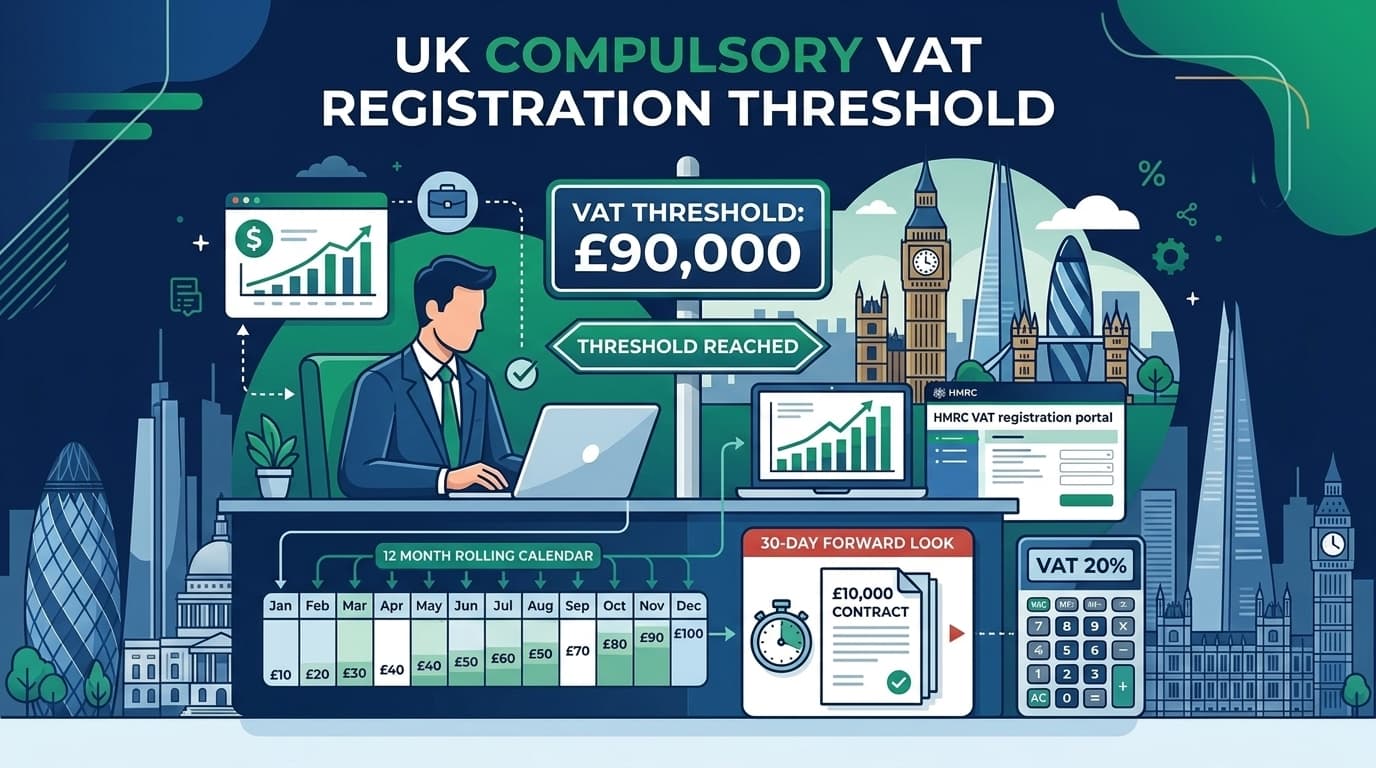
Your business has made £84,000 in taxable sales over the last 12 months. You have just signed another £10,000 contract.
Do you need to register for VAT?
Possibly.
The UK VAT registration rules do not simply look at your annual accounts or wait until your financial year ends. HMRC uses specific turnover tests, including a rolling 12-month test and a separate 30-day forward-looking test.
That means a business can cross the VAT threshold without immediately realising it.
If your business is approaching £90,000, has recently crossed it, or is expecting a large contract, understanding the rules now can help you avoid an unexpected VAT liability later.
Quick Answer: What Is the UK VAT Registration Threshold?
The compulsory VAT registration threshold in the UK is currently £90,000 of taxable turnover.
You generally need to register if:
- Your taxable turnover has gone over £90,000 in the previous 12 months; or
- You expect your taxable turnover to exceed £90,000 in the next 30 days alone.
The £90,000 figure is based on taxable turnover, not profit. It is also not an annual allowance that resets at the end of your financial or tax year.
If you are based outside the UK, different VAT registration rules can apply. HMRC's current guidance confirms that the standard UK registration threshold is £90,000.
UK VAT Threshold at a Glance
| VAT Rule | Current Position |
|---|---|
| VAT registration threshold | £90,000 taxable turnover |
| Deregistration threshold | £88,000 |
| Rolling test | Previous 12 months |
| Forward-looking test | Next 30 days alone |
| Voluntary registration | Possible below £90,000 |
| Zero-rated sales | Count towards taxable turnover |
| Exempt sales | Generally do not count |
| Overseas businesses | Separate rules may apply (NETP) |
The thresholds can change, so businesses should check the latest HMRC guidance when making a registration decision.
The £90,000 VAT Threshold Is Not an Annual Allowance
This is one of the most important points to understand.
The VAT threshold does not mean:
Instead, HMRC looks at your taxable turnover over a rolling period of 12 months.
For example, suppose your financial year runs from April to March. You cannot simply wait until 31 March and ask whether your annual turnover exceeded £90,000. HMRC's test is different.
At the end of each month, you need to consider the relevant 12-month period and determine whether your taxable turnover has gone over £90,000.
This is why businesses close to the threshold should monitor their turnover regularly rather than checking once a year.
What Is Taxable Turnover for VAT?
Taxable turnover is broadly the total value of your VAT-taxable supplies, excluding VAT itself.
It can include:
It does not simply mean every amount appearing in your bank account.
The VAT threshold is not based on:
- Your profit
- Your cash balance
- Your net profit after expenses
- Your personal income
- Your accounting-year profit
- Every type of income your business receives
Why Zero-Rated Sales Matter
Zero-rated sales are particularly important.
A zero-rated supply has a VAT rate of 0%, but it is still a taxable supply. Therefore, qualifying zero-rated sales can count towards the £90,000 registration threshold.
How the Rolling 12-Month VAT Test Works
The first major test looks backwards. If your taxable turnover for the previous 12 months goes over £90,000, you may become liable to register for VAT.
The important point is that the 12 months are rolling.
Example: Rolling Monthly Turnover
Imagine a consultancy has the following taxable turnover:
Total 12-Month Turnover: £94,500 (Exceeds £90,000)
By the end of September, the business's taxable turnover for the relevant 12-month period has exceeded £90,000. It cannot wait until the end of its financial year to deal with VAT.
For the rolling test, the business generally has to notify HMRC within 30 days of the end of the month in which it became liable.
The effective registration date is normally the first day of the second month after the month in which the threshold was exceeded.
This is why checking turnover once a year is not enough. Businesses approaching the threshold should monitor their position monthly.
What Is the 30-Day VAT Rule?
There is another rule that catches businesses out because it looks forward rather than backwards.
You may need to register if you have reasonable grounds to expect your taxable turnover to exceed £90,000 in the next 30 days alone.
This is separate from the rolling 12-month calculation.
Example: A Large New Contract
A consultancy has only made £60,000 of taxable sales over the previous 12 months. It then signs a contract worth £100,000, with the relevant taxable supplies expected to fall within the next 30 days.
Its previous 12-month turnover is still below £90,000. But that does not necessarily keep the business outside VAT registration. The 30-day forward-looking test may apply.
The effective registration date under this test is generally the date the business realised that its taxable turnover would exceed the threshold.
This is why signing a major contract can create a VAT issue before your annual turnover appears to be above £90,000.
If you are about to accept a large contract, check the VAT position before agreeing the commercial terms.
Which Sales Count Towards the £90,000 Threshold?
A simplified guide is:
| Type of Supply | Counts Towards £90,000? |
|---|---|
| Standard-rated supplies (20%) | Yes |
| Reduced-rated supplies (5%) | Yes |
| Zero-rated supplies (0%) | Yes |
| Exempt supplies | Generally no |
| Out-of-scope supplies | Generally no |
The exact treatment can depend on the nature and place of the supply. This becomes more complicated where a business has a mixture of taxable and exempt activities, or where special VAT rules apply.
If your turnover is close to £90,000, do not assume that every invoice should simply be added together without checking how each supply is treated for VAT purposes.
What If My Turnover Is £91,000?
If your taxable turnover has gone over £90,000 under the applicable registration test, being only £1,000 over the threshold does not create a special buffer.
The question is not whether you are significantly over the threshold. The question is whether you have become liable to register.
The date you crossed the threshold matters because it determines your notification and effective registration requirements.
My Turnover Is Close to £90,000. What Should I Do?
If you are at £80,000, £85,000 or £89,000, do not wait until you reach £90,000 before looking at VAT.
Instead:
This is particularly important for businesses experiencing rapid growth. A company that goes from £70,000 to £90,000 quickly can have very different VAT considerations from a business that has remained around £70,000 for several years.
What Happens After You Cross the VAT Threshold?
If you become liable to register, you need to deal with the registration rather than simply waiting for HMRC to contact you.
The process broadly involves:
1. Identify When You Became Liable
Determine whether you crossed the threshold under the previous 12-month test or the next-30-days test.
2. Work Out the Effective Date
The effective date depends on which registration test applies. The backward-looking and forward-looking tests do not use the same rules.
3. Notify HMRC
You must notify HMRC within the applicable statutory deadline.
4. Prepare for VAT Compliance
Charge VAT where applicable, keep records, issue compliant VAT invoices, and submit periodic VAT returns.
If you need ongoing support after registration, Leadforce provides VAT return filing services to help businesses manage their recurring VAT filing obligations.
Registration is therefore more than obtaining a VAT number. It changes how you manage your sales, invoices, accounting and tax reporting.
I've Already Gone Over £90,000. What Should I Do?
If you have just discovered that your taxable turnover has exceeded the threshold, do not ignore it. Start by establishing exactly what happened.
Check These Five Things
Look at the relevant rolling 12-month periods rather than only your financial year.
A major contract or sale could create a separate registration obligation.
Check whether zero-rated, exempt and out-of-scope supplies have been classified correctly.
This is critical because it determines when your VAT obligations begin.
If VAT should have been accounted for from an earlier effective date, you may face an unexpected liability.
Why Acting Quickly Matters
Late registration can lead to:
- • VAT becoming payable from the relevant effective date
- • Penalties for failing to notify on time
- • Interest on amounts paid late
- • Difficulties recovering VAT from customers retrospectively
- • Additional accounting and compliance work
The consequences depend on the circumstances. If you think you have missed the registration deadline, it is better to review the position promptly than to keep trading and hope the issue disappears.
For businesses dealing with an existing VAT issue, VAT compliance services can provide a relevant next step for reviewing filing and compliance requirements.
Can I Register for VAT Before Reaching £90,000?
Yes. A business making taxable supplies can generally choose voluntary VAT registration even when its taxable turnover is below £90,000. But voluntary registration is not automatically beneficial.
Potential Advantages
- • Your customers are mainly VAT-registered businesses.
- • You have significant VAT-bearing business expenses.
- • You expect to grow beyond the threshold soon.
- • Recovering eligible input VAT is commercially important.
Potential Disadvantages
- • Charging VAT where applicable
- • Keeping additional VAT records
- • Preparing and submitting VAT returns
- • Meeting strict HMRC VAT deadlines
- • Managing the effect of VAT on your pricing
For a business selling mainly to consumers, voluntary registration can have a different commercial impact from a B2B business selling primarily to VAT-registered customers.
If you do register, understanding what you can reclaim through VAT can also be important, particularly where the business has eligible VAT-bearing expenses.
Can HMRC Allow an Exception?
In limited circumstances, a business that has exceeded the threshold may be able to apply for an exception from registration.
One situation can arise where the business's taxable turnover temporarily exceeds £90,000 but HMRC is satisfied that taxable turnover over the relevant following 12-month period will not exceed the applicable deregistration threshold (£88,000).
However, this is not an automatic exemption.
You need to provide information to HMRC and meet the relevant conditions. If your turnover is temporarily high, do not assume you can simply ignore the registration requirement.
Does the £90,000 Threshold Apply to Overseas Businesses?
Not always. This is particularly important for international founders and companies selling into the UK.
HMRC states that the standard UK registration threshold is not available to non-established taxable persons (NETPs). An overseas business making taxable supplies in the UK may therefore have a VAT registration obligation even when its turnover is below £90,000.
There are also specific rules depending on factors such as:
- • Where the business is established
- • Where the goods or services are supplied
- • Whether special VAT rules apply
- • Whether goods are imported into the UK
- • How the transaction is structured
Leadforce provides support relating to VAT on imports and cross-border trade for businesses dealing with international transactions.
What If I Want a UK VAT Registered Company Immediately?
The VAT threshold is particularly relevant to businesses considering whether to establish a new UK company or acquire an existing VAT-registered business.
A business that needs a UK company with an existing VAT registration may explore a readymade UK VAT registered company rather than starting with a newly incorporated company and waiting for its own VAT registration process.
However, buying an existing VAT-registered company is not the same as simply buying a VAT number. The company's history, ownership transfer, tax position, VAT status and suitability for the intended business activity all need to be reviewed carefully.
VAT Deregistration: What Happens If Turnover Falls?
VAT registration is not necessarily permanent. If your business is already VAT registered and its taxable turnover falls, you may be able to cancel the registration if you meet HMRC's deregistration conditions.
The current deregistration threshold is £88,000. This is different from the £90,000 compulsory registration threshold.
If you believe your business may no longer need to remain VAT registered, you can learn more about VAT deregistration before deciding what to do.
Do not cancel a VAT registration simply because your turnover has fallen below £90,000. The relevant deregistration rules and expected future turnover need to be considered.
Five Common VAT Threshold Mistakes
1. Checking Turnover Only Once a Year
The VAT test is not based on your financial year.
Better approach: review taxable turnover monthly.
2. Using Profit Instead of Turnover
A business can have low profit and still need to register for VAT.
Better approach: calculate taxable turnover before deducting business expenses.
3. Forgetting Zero-Rated Sales
Zero-rated does not mean non-taxable.
Better approach: include qualifying zero-rated supplies in the threshold calculation.
4. Ignoring the 30-Day Test
A business can be below £90,000 based on its historical turnover and still become liable because of expected taxable turnover in the next 30 days.
Better approach: review major contracts before signing them.
5. Assuming Overseas Businesses Get the Same £90,000 Threshold
NETP rules can work differently.
Better approach: establish whether your business is UK-established for VAT purposes before relying on the standard threshold.
VAT Registration Checklist for Businesses Near £90,000
How Leadforce Can Help With UK VAT Registration
Understanding the VAT threshold is one thing. Applying the rules to your actual business can be more difficult, particularly when you have mixed supplies, rapid growth, overseas operations or a large new contract.
Leadforce can support businesses with UK VAT registration and related VAT requirements, including reviewing your position and helping you understand the registration process.
Our approach is focused on the facts of your business rather than assuming that the £90,000 threshold applies in exactly the same way to everyone.
If you are:
- • Approaching £90,000 in taxable turnover
- • Unsure whether you have already crossed the threshold
- • Planning a major UK contract
- • Considering voluntary VAT registration
- • Operating a business from outside the UK
- • Looking at VAT registration, refunds or deregistration
Need Help With Your UK VAT Position?
Speak to the Leadforce team about your specific circumstances, turnover tests, or ongoing compliance support.
Frequently Asked Questions
What Is the VAT Registration Threshold in the UK?
The current compulsory VAT registration threshold is £90,000 of taxable turnover. A UK-established business generally needs to register if its taxable turnover exceeds £90,000 over the relevant previous 12-month period or it expects to exceed £90,000 in the next 30 days alone.
Is the VAT Threshold Based on Profit?
No. VAT registration is based on taxable turnover, not profit. Your business expenses and operating costs do not reduce the taxable turnover figure used for the registration test.
Is the £90,000 VAT Threshold Per Tax Year?
No. The main test is based on a rolling 12-month period. It does not simply reset when your financial year or UK tax year ends.
Do Zero-Rated Sales Count Towards the VAT Threshold?
Yes. Zero-rated supplies are still taxable supplies, so qualifying zero-rated sales count towards the £90,000 threshold.
Do Exempt Sales Count Towards VAT Registration?
Generally, no. Exempt and out-of-scope supplies are treated differently from taxable supplies and generally do not form part of taxable turnover for the standard registration test.
What Is the 30-Day VAT Rule?
The 30-day rule applies when you have reasonable grounds to expect your taxable turnover to exceed £90,000 in the next 30 days alone. This can be relevant when you receive a large contract or expect a significant one-off sale. HMRC and the legislation distinguish this test from the previous-12-month test.
What Happens If My Turnover Is £91,000?
If the £91,000 represents taxable turnover and you have exceeded the £90,000 threshold under the applicable registration test, you may be required to register for VAT. The date you crossed the threshold and the test that applies determine the registration and notification requirements.
Can I Register for VAT Before Reaching £90,000?
Yes. Businesses making taxable supplies can generally apply for voluntary VAT registration below the compulsory threshold. Whether this is commercially worthwhile depends on factors such as your customers, pricing and business expenses.
What Is the VAT Deregistration Threshold?
The current VAT deregistration threshold is £88,000. A business may be able to cancel its VAT registration if it meets HMRC's deregistration conditions and reasonably expects its taxable turnover to remain below the relevant limit.
What Happens If I Register for VAT Late?
You may have to account for VAT from the relevant effective date and could face penalties and interest depending on the circumstances. You may also have difficulty recovering VAT from customers if you originally invoiced them without VAT.
How Do I Register for VAT in the UK?
VAT registration is generally completed through HMRC using GOV.UK. You will need relevant information about your business, its activities and turnover. HMRC will determine the registration details and effective date according to the applicable rules.
Does the £90,000 Threshold Apply to Overseas Businesses?
Not necessarily. Non-established taxable persons can be subject to different UK VAT registration rules and may need to register when they make taxable supplies in the UK regardless of the standard £90,000 threshold.
Do Sole Traders and Limited Companies Have the Same VAT Threshold?
The £90,000 threshold is not increased simply because a business operates as a sole trader or limited company. However, businesses and legal entities must be assessed according to their individual VAT circumstances, and connected or associated businesses can require additional consideration.
Can HMRC Allow an Exception From VAT Registration?
In limited circumstances, HMRC may allow an exception where the relevant conditions are met, such as certain temporary increases in taxable turnover. You must satisfy HMRC's requirements; an exception should never be assumed.
How Often Should I Check My VAT Turnover?
If your business is approaching the threshold, checking taxable turnover monthly is a sensible way to identify when the rolling 12-month test may be approaching £90,000. You should also review expected transactions over the next 30 days.
Final Thoughts
The UK VAT registration threshold is currently £90,000, but the number itself is only the starting point.
The real question is: How much taxable turnover has your business made over the relevant period, and what do you expect to happen next?
The rolling 12-month test, the 30-day forward-looking test, zero-rated sales and special rules for overseas businesses can all affect the answer.
If your turnover is approaching £90,000, do not wait until the end of the year to check.
Monitor it monthly, review major contracts before they are signed and act quickly if you believe you have already crossed the threshold.
If you need help understanding your UK VAT position, filing VAT returns, reclaiming eligible VAT, dealing with compliance issues or considering a VAT-registered company, speak to Leadforce today.