
 Whatsapp
How to Buy a VAT Registered Company Off the Shelf in the UK
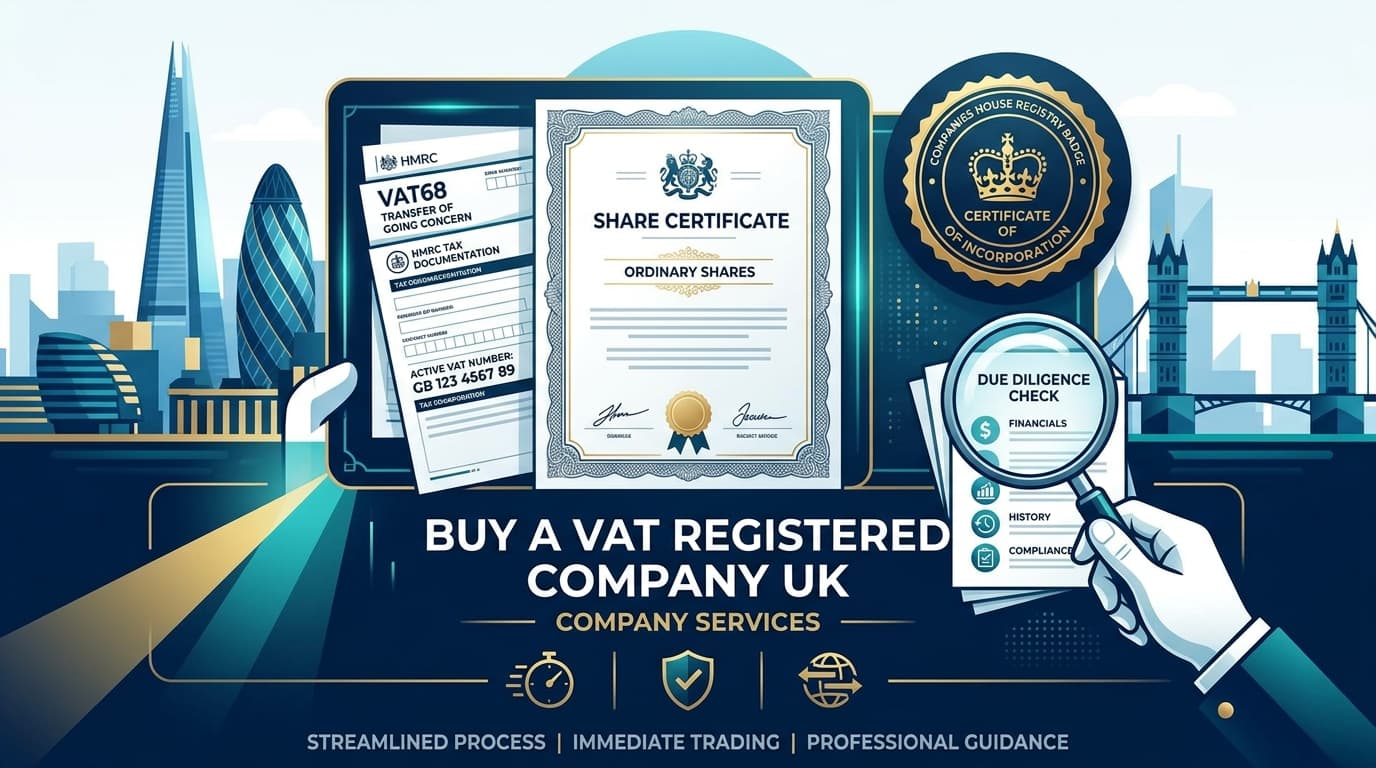
If you're setting up a business in the UK and want to start trading with a VAT number already in place, you may be wondering whether you can simply buy a VAT registered company off the shelf rather than incorporating from scratch and waiting for HMRC to process a new registration. It's a reasonable question — and the answer is more nuanced than most sales pages suggest.
For businesses looking to acquire an established VAT-registered entity, Leadforce’s Buy UK VAT Registered Company service provides access to available UK companies, subject to due diligence and applicable HMRC requirements.
Quick Answer
Yes, you can buy a UK company that already holds a VAT registration, but you cannot simply "add" an existing VAT number to a brand-new shelf company the way you might add a domain name. The VAT number stays tied to the original entity unless HMRC approves a formal transfer using form VAT68, and the new owner takes on the seller's VAT history, including any outstanding liabilities. Genuine ready-made companies with a clean, transferable VAT registration exist, but they are far less common than standard non-VAT shelf companies, and due diligence is essential before you buy one.
What Is a VAT Registered Shelf Company?
A shelf company (sometimes called an off the shelf company or ready-made company) is a UK limited company that has already been incorporated at Companies House, often with no trading activity, and is sold on to a new owner who wants a company that's ready to use immediately rather than waiting for standard incorporation.
A VAT registered shelf company is simply a shelf company that already carries an active VAT registration number, rather than one that is dormant and unregistered for VAT.
This matters because:
How VAT Registration Actually Transfers When You Buy a Company
This is the part most searches on this topic get wrong. There are two very different scenarios, and it's important not to confuse them.
Scenario 1: You buy the shares of an existing company
If you buy 100% of the shares in a company that already holds a VAT number, the company itself doesn't change — only its ownership does. The VAT registration, VAT number, and VAT history all stay exactly as they are, because the legal entity hasn't changed, only its shareholders and possibly its directors. This is the closest thing to genuinely "buying a VAT registered company off the shelf."
Scenario 2: You buy the business or assets, and want to keep the VAT number
If instead you're acquiring the trade and assets of a business (a Transfer of a Going Concern, or TOGC) and want to continue using the seller's VAT number rather than registering fresh, HMRC requires both the buyer and seller to complete form VAT68, which is treated as the seller's cancellation of their VAT registration and the buyer's application to take over the same number.
Under this route:
- HMRC does not require the seller to submit a separate VAT7 cancellation form — the VAT68 covers this.
- The seller must confirm on the form that they have transferred the business or changed their legal status, and formally agree to transfer their VAT number to the new owner.
- HMRC typically takes around three weeks to process a VAT68 request, though delays are possible and can temporarily affect input VAT recovery.
- Once the transfer is approved, the previous registration is cancelled from the agreed date and the new owner becomes legally responsible for VAT from that point onward.
Crucially, this decision is irreversible once approved: HMRC's own VAT68 guidance states that once a VAT registration number has been transferred, the transfer cannot be undone.
Why the VAT number transfer carries risk
By signing the VAT68, the buyer doesn't just inherit a number — they inherit history. The buyer effectively confirms they are taking on any potential VAT liabilities of the previous owner, and both parties can be held jointly liable for VAT debts that arose before the transfer took place. This is the single biggest reason buying a "VAT registered shelf company" needs proper due diligence rather than a quick purchase.
Step-by-Step: Buying a VAT Registered Company in the UK
Identify a genuine VAT registered company for sale
Confirm with the provider or seller whether the VAT number belongs to the company you're buying shares in, or whether it would need a VAT68 transfer as part of a business/asset sale. These are very different transactions.
Check the company at Companies House
Review the filing history, confirmation statements, persons with significant control (PSC) register, and any charges or mortgages registered against the company.
Request the VAT compliance history
Ask for evidence of past VAT returns, payment history, and confirmation of no outstanding HMRC debts or open compliance checks.
Carry out financial and legal due diligence
Even a "dormant" shelf company should be checked for hidden liabilities, unpaid taxes, or historic contracts that could transfer with it.
Complete the share transfer or business transfer documentation
This includes stock transfer forms, updated statutory registers, and Companies House notifications (such as PSC and director changes) where relevant.
Submit form VAT68 if the VAT number itself needs transferring
Both the outgoing and incoming parties must sign, and the buyer must also register for VAT as the new owner alongside submitting the VAT68.
Update HMRC and third parties
The new owner should contact HMRC within 21 days of the transfer application if they want to retain the seller's appointed accountant, and should set up new direct debits and self-billing arrangements as needed.
Notify banks, suppliers and clients
Inform financial institutions, suppliers, and B2B clients of the change in ownership and, where relevant, the effective date of the VAT transfer.
Costs to Consider
There isn't a single fixed "price" for a VAT registered shelf company — costs vary depending on the provider, the company's trading history, and whether a VAT68 transfer is involved. As a buyer, budget for:
Benefits and Risks: Shelf Company vs Fresh VAT Registration
| Feature | VAT Registered Shelf Company | New Company + Fresh VAT |
|---|---|---|
| Purpose | Start trading with VAT status already in place | Full control over company history and clean VAT record |
| Speed | Potentially faster if VAT already active and history is clean | Incorporation is fast; VAT registration timing depends on HMRC processing |
| Requirements | Due diligence on VAT history, VAT68 transfer if applicable | Standard incorporation plus fresh VAT application |
| Advantages | May suit buyers wanting an established VAT number for supplier/client credibility | No inherited VAT liabilities or compliance history |
| Limitations | Buyer may inherit joint liability for past VAT debts | No existing trading or credit history |
| Suitable for | Buyers prioritising an active VAT number over a clean slate | Buyers who prioritise a fully clean, traceable history |
Common Mistakes to Avoid
Assuming VAT registration automatically comes with the shelf company
It doesn't transfer automatically — it requires either a share purchase (where the entity is unchanged) or an approved VAT68 transfer.
Skipping VAT history checks
A "clean" looking company can still carry unresolved HMRC compliance issues.
Not clarifying joint liability
Buyers sometimes don't realise they can be pursued for VAT debts that predate their ownership.
Confusing dormant companies with active VAT registrations
A dormant company for Companies House purposes can still hold an active VAT registration that needs managing or deregistering correctly.
Rushing the purchase for speed alone
Given that HMRC's own processing time for a VAT68 transfer typically runs to around three weeks, the time saved versus registering fresh may be smaller than expected once due diligence is factored in.
VAT Registration Threshold Context
The UK VAT registration threshold has been £90,000 of taxable turnover since 1 April 2024, and remains unchanged for the 2026/27 tax year.
This is relevant to buyers because it affects whether voluntary VAT registration (rather than acquiring an already-registered company) might be the simpler route if your turnover is currently below this threshold. Voluntary VAT registration remains available to any business regardless of turnover, which is often overlooked by buyers assuming they need to acquire an existing registration to trade with VAT status.
Frequently Asked Questions
Can I buy a shelf company that already has a VAT number?
Yes, if you're buying the shares of a company that already holds an active VAT registration, the registration stays with the company automatically. If you're buying a business or its assets rather than shares, the VAT number only transfers if HMRC approves a VAT68 application.
Is buying a VAT registered company faster than registering for VAT myself?
Not necessarily. Incorporating a new company is now very quick, and a VAT68 transfer typically takes around three weeks to process, so any time saved needs to be weighed against the due diligence required on an existing company's VAT history.
Do I inherit the previous owner's VAT liabilities?
Potentially, yes. By signing a VAT68 transfer, the new owner takes on responsibility for VAT liabilities associated with the registration, and both parties can be held jointly liable for VAT debts arising before the transfer. This makes due diligence essential.
What is form VAT68 used for?
Form VAT68 is used when a business is transferred as a going concern or a company changes legal entity, and the new owner wants to keep the previous VAT registration number rather than applying for a new one.
Can the VAT transfer be reversed if I change my mind?
No. HMRC confirms that once a VAT registration number has been transferred, the transfer cannot be undone.
What due diligence should I carry out before buying a VAT registered company?
At minimum, check the Companies House filing history and PSC register, request VAT return and payment history, confirm there are no open HMRC compliance checks, and have a solicitor or accountant review any contracts or liabilities that would transfer with the business.
Is a dormant company the same as a VAT registered shelf company?
Not always. A company can be dormant for Companies House purposes (no significant trading activity) while still holding an active VAT registration that needs to be managed, transferred, or deregistered correctly.
How Leadforce Can Help
Buying an existing UK company — particularly one with an active VAT registration — involves company law, HMRC compliance and financial due diligence working together correctly. Leadforce supports founders and businesses through company formation, VAT registration guidance, and the practical steps involved in acquiring or restructuring a UK company, helping you understand exactly what you're taking on before you commit to a purchase.
If you're weighing up whether to buy an existing VAT registered company or incorporate and register fresh, the Leadforce team can help you understand your options and the requirements involved at each stage.