
 Whatsapp
When Does a Company Need to Register for VAT in the UK?
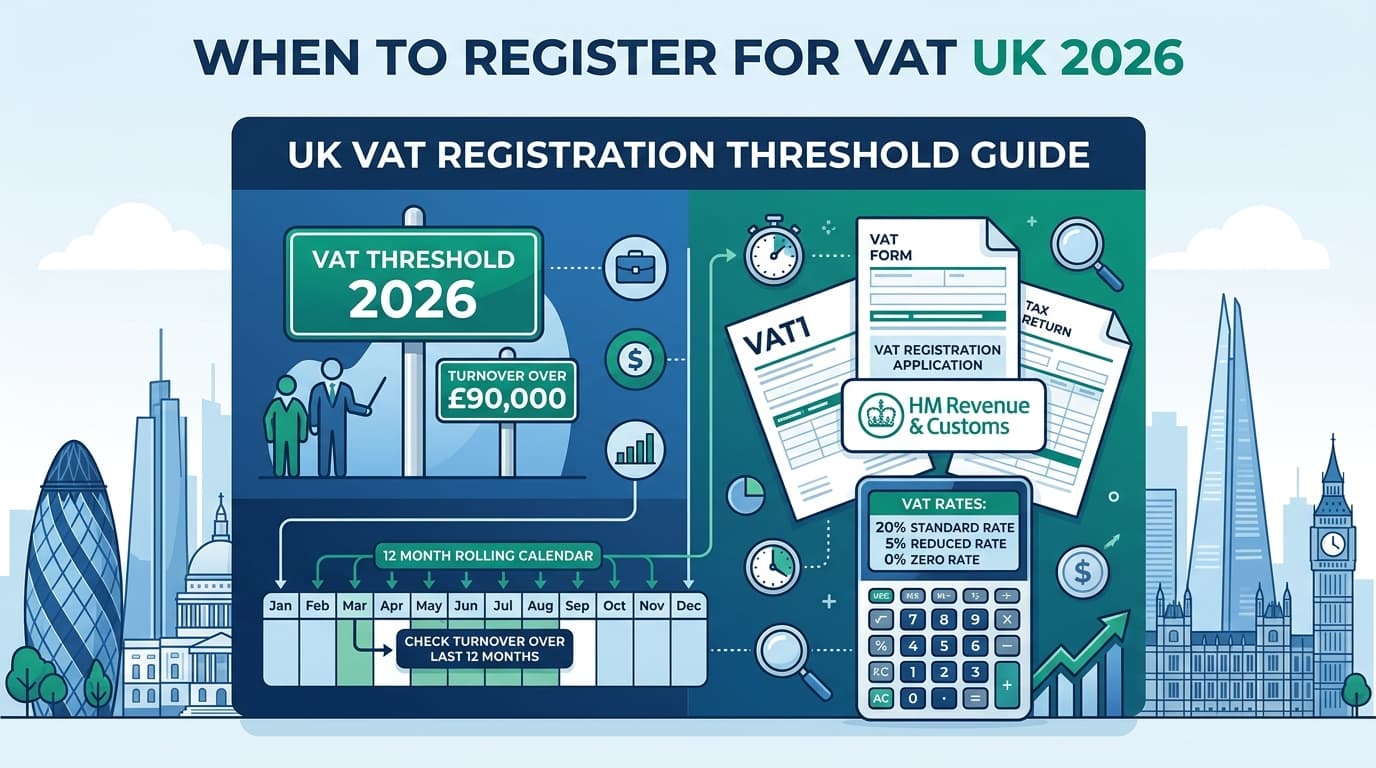
If you run a UK business, VAT registration isn't something you choose to think about — HMRC decides the moment for you, based on your turnover. Get the timing wrong, and you could face a backdated VAT bill plus penalties. Get it right, and VAT registration becomes a manageable part of running a growing business, not a shock.
This guide explains exactly when registration becomes compulsory, how the calculation actually works, what counts toward your turnover, and when it might make sense to register early even if you don't have to.
If you're considering buying an established UK business, Leadforce can also help you explore VAT-registered company options. You can learn more about how to buy a UK VAT registered company and the factors to consider before purchasing an existing business.
Quick Answer
A UK company must register for VAT with HMRC once its taxable turnover exceeds £90,000 in any rolling 12-month period, or if it expects to exceed £90,000 in the next 30 days alone. This is not tied to the tax year or your accounting year — you must check your turnover at the end of every month. Registration must be completed within 30 days of crossing the threshold. Non-UK businesses supplying goods to UK customers may need to register regardless of turnover.
The VAT Registration Threshold Explained
The current UK VAT registration threshold is £90,000, and it has applied since 1 April 2024, having previously been £85,000. It remains unchanged for the 2026/27 tax year.
The deregistration threshold — the point below which an already-registered business can apply to leave the VAT system — is set slightly lower, at £88,000. This gap exists deliberately, so a business that dips just below £90,000 for a short period isn't forced to jump in and out of registration repeatedly.
It's worth stressing what the threshold is not: it isn't your annual profit, your company's financial year figure, or a fixed calendar-year measure. It's a rolling test, recalculated monthly, which is where most confusion — and most accidental non-compliance — happens.
How the Rolling 12-Month Rule Actually Works
HMRC doesn't wait for your accounting year-end to check whether you've crossed the threshold. Instead, at the end of every calendar month, you're expected to look back over the previous 12 months and add up your taxable turnover.
Worked Example: The 12-Month Look-Back
A design consultancy checks its figures at the end of August 2026 and finds its taxable turnover for the 12 months to 31 August 2026 has reached £92,000. Because this exceeds £90,000, the business must notify HMRC by 30 September 2026. Its effective VAT registration date becomes 1 October 2026 — the point from which it must start charging VAT on its sales.
This "look-back" habit needs to become routine for any growing business, particularly one hovering in the £70,000–£85,000 range, because it's easy to cross the line mid-year without noticing, especially if turnover fluctuates seasonally.
What Counts as Taxable Turnover
Taxable turnover is the total value of everything you sell that is not VAT-exempt or "out of scope." Critically, this includes:
It does NOT include:
One of the most common misconceptions is assuming zero-rated sales are irrelevant to the threshold calculation. They aren't — a business selling almost entirely zero-rated goods can still be legally required to register, even though it may never actually collect any VAT from customers.
The "Future Turnover" Test
Alongside the rolling 12-month look-back, there's a second, less well-known trigger: the 30-day forward test.
If, at any point, you have reasonable grounds to believe your taxable turnover will exceed £90,000 in the next 30 days alone, you must register immediately — your registration takes effect from the start of that 30-day period, not from a future date.
Example: Forward-Looking 30-Day Trigger
On 1 May, a business signs a single £100,000 contract to be delivered and paid within that month. Even though its trailing 12-month turnover might be modest, it must notify HMRC straight away, with an effective registration date of 1 May.
This test exists specifically to catch businesses that land a single large contract or one-off project that would push them well over the threshold before month-end.
Compulsory vs Voluntary VAT Registration
Not every business waits until it's forced to register. Many choose to register voluntarily, often to reclaim VAT on purchases or to appear more established to VAT-registered clients.
| Feature | Compulsory Registration | Voluntary Registration |
|---|---|---|
| Trigger | Turnover exceeds £90,000 (rolling 12-month or 30-day forward test) | Business choice, below £90,000 |
| Deadline | Must register within 30 days of the trigger | No fixed deadline — register when ready |
| VAT reclaim | Can reclaim VAT on eligible purchases | Same reclaim rights once registered |
| Admin burden | Quarterly returns, MTD-compliant digital records | Same ongoing obligations apply |
| Best suited to | Businesses already over, or about to cross, the threshold | B2B businesses with mostly VAT-registered clients, or those with significant reclaimable input VAT |
| Risk | Penalties if registration is missed or delayed | None — but adds admin cost and may increase prices for non-VAT-registered customers |
Voluntary registration tends to suit businesses selling mainly to other VAT-registered companies (since those clients can reclaim the VAT charged), or businesses with high upfront costs — such as equipment purchases — where reclaiming input VAT provides a genuine cash-flow benefit.
VAT Registration for Overseas Businesses
The £90,000 threshold applies to UK-established businesses. It does not apply in the same way to overseas sellers.
A non-established taxable person (NETP) — broadly, a business without a UK business establishment that makes taxable supplies in the UK — generally has to register for VAT from the very first sale, regardless of turnover. This commonly affects overseas ecommerce sellers holding stock in UK fulfilment warehouses, including certain marketplace sellers.
If this might apply to your business, HMRC's guidance on non-established taxable persons (VAT Notice 700/1) sets out the specific rules, and it's worth getting this checked early, since the zero-threshold rule catches many overseas businesses by surprise.
What Happens If You Register Late
Missing the 30-day registration deadline has two separate financial consequences:
1. Backdated VAT
You must account for VAT on all sales made from the date you should have registered — even if you never charged your customers VAT at the time. This is calculated on the value of those sales, not added on top.
2. Failure-to-Notify Penalties
Under HMRC's failure-to-notify regime (VAT Notice 700/41), the penalty is a percentage of the VAT that should have been paid during the period you were unregistered:
| How late you registered | Penalty rate |
|---|---|
| Not more than 9 months late | 5% |
| More than 9 but not more than 18 months late | 10% |
| More than 18 months late | 15% |
There's a minimum penalty of £50, and the exact rate applied can be reduced depending on how and when you disclose the failure — coming forward to HMRC before they contact you generally results in more favourable treatment than waiting to be caught.
Registration Exception: If you temporarily exceed the threshold but can demonstrate your turnover will fall back below £88,000 within the next 12 months, you may be able to apply to HMRC for a registration exception, avoiding the need to register at all for what turns out to be a short-term spike.
How to Register for VAT
1Check your rolling 12-month turnover
Review your sales ledger at the end of each calendar month to track total taxable turnover.
2Notify HMRC within 30 days
Submit notification to HMRC within 30 days of crossing the threshold (or immediately if the 30-day forward test applies).
3Register online via GOV.UK
Complete your application through your Government Gateway account, or via a paper VAT1 form in specific circumstances.
4Receive your VAT registration certificate (VAT4)
HMRC will issue your official certificate containing your VAT number, typically within 30 working days.
5Start charging VAT
Charge the appropriate VAT rate on all taxable sales starting from your effective date of registration.
6Set up Making Tax Digital (MTD) software
Digital record-keeping and quarterly return submissions are mandatory under MTD rules from your very first VAT return.
Registering directly with HMRC via GOV.UK is free — there's no government fee, though many businesses choose to pay an accountant to handle the process and initial setup.
Common Mistakes to Avoid
Checking turnover against the tax year instead of a rolling 12 months
This is the single biggest source of accidental late registration.
Assuming zero-rated sales don't count
Zero-rated sales count toward the £90,000 threshold in full.
Ignoring the 30-day forward test
Signing a large one-off contract triggers instant registration obligations.
Ignoring overseas seller rules
Non-established businesses storing stock in UK fulfilment centres must register with no minimum threshold.
Ignoring VAT because a business "feels small"
Gross turnover, not profit or business size, is the only metric HMRC assesses.
Frequently Asked Questions
Do sole traders and partnerships follow the same threshold as limited companies?
Yes. The £90,000 threshold applies to the taxable person — an individual sole trader, a partnership, or a limited company — regardless of legal structure.
If I run two separate trades as a sole trader, do I get two thresholds?
No. HMRC treats you as one taxable entity, so your combined turnover across all trading activities counts toward the single £90,000 threshold.
Can I register for VAT before I reach the threshold?
Yes, this is voluntary registration, and it's a legitimate choice for many growing businesses, particularly those selling to other VAT-registered companies.
What if my turnover briefly goes over £90,000 but I expect it to drop back down?
You may be able to apply to HMRC for a registration exception if you can show your taxable turnover won't exceed £88,000 over the following 12 months.
Does buying goods from EU suppliers affect my VAT position?
It can. If you only sell VAT-exempt or out-of-scope goods but buy more than £90,000 of goods from EU VAT-registered suppliers within a 12-month period, you may still need to register.
What happens if I take over an existing VAT-registered business?
If you take over a business as a going concern, the combined taxable turnover of the old and new business — for the 12 months leading up to the takeover — is used to assess whether registration is required.
Is VAT registration free?
Yes, registering directly through GOV.UK carries no government fee. Costs only arise if you engage an accountant to manage the process or ongoing compliance.
How Leadforce Can Help
Working out exactly when your turnover crosses the threshold — and getting the registration process right the first time — is easier with the right support in place. Leadforce assists UK and international business owners with VAT registration assessments, HMRC notification, and setting up compliant Making Tax Digital record-keeping from day one. We also help overseas businesses understand their UK VAT obligations before they start trading, so registration is handled correctly rather than retrospectively.
If you're approaching the VAT threshold or unsure whether your business already needs to register, the Leadforce team can help you review your turnover position and manage the registration process with HMRC.