
 Whatsapp
What Is the VAT Threshold in the UK?
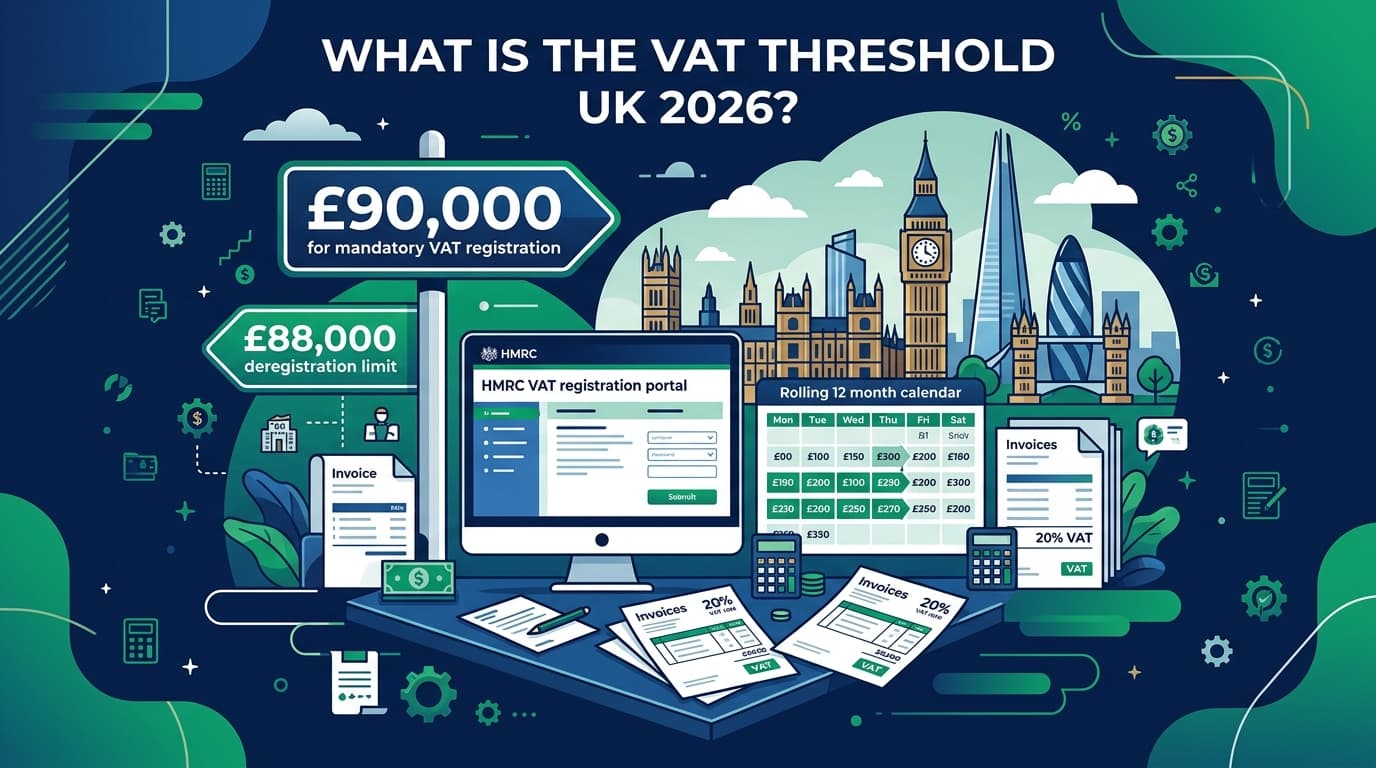
If your business's taxable turnover has crept towards £90,000, you've probably started wondering whether VAT registration is about to become compulsory. It's a milestone that catches out a surprising number of sole traders and small company directors, not because the figure is a secret, but because the way HMRC calculates it rarely matches how business owners track their own sales.
This guide explains exactly what the UK VAT threshold is, how it's calculated, what happens once you cross it, and when voluntary registration might actually work in your favour.
If you're already approaching the threshold and need to understand your registration options, Leadforce can also help with UK VAT registration services and related business requirements.
Quick Answer
The UK VAT registration threshold is £90,000 of taxable turnover in any rolling 12-month period, not the tax year or calendar year. Once you go over this figure, you must notify HMRC within 30 days of the end of that month. The deregistration threshold, for businesses whose turnover has fallen, is £88,000. Both figures have applied since 1 April 2024 and remain unchanged for 2026/27.
What Is Taxable Turnover?
Taxable turnover is the total value of everything your business sells that isn't VAT-exempt or "out of scope." Crucially, it isn't the same as profit, and it isn't limited to sales where you'd charge the standard 20% rate.
Taxable turnover includes:
It does NOT include:
Common pitfall: A company selling £70,000 of standard-rated goods and £25,000 of zero-rated goods has £95,000 of taxable turnover, even though no VAT was ever charged on the zero-rated portion. It's already over the threshold.
The Rolling 12-Month Rule
This is the part of the VAT threshold that genuinely surprises people. HMRC does not assess your turnover against your accounting year, your tax year, or the calendar year. It looks at any rolling consecutive 12-month period, reassessed at the end of every month.
In practice, that means you should be checking your taxable turnover for the trailing 12 months every single month, not just once a year at your accounts deadline.
If your rolling total goes over £90,000 at the end of any month:
Timeline Example: If your rolling 12-month turnover to 31 July exceeds £90,000 for the first time, you must register by 30 August, with an effective registration date of 1 September.
The Forward-Look Test
Less well known than the rolling 12-month rule, the forward-look test requires immediate registration if you have reasonable grounds to expect your taxable turnover will exceed £90,000 in the next 30 days alone — not over a year, just the next month.
This typically applies when a business is about to sign a large contract or take on a significant one-off order. If accepting that contract would push turnover over £90,000 within 30 days, registration is required straight away, with no 30-day grace period to notify HMRC afterwards.
If you're negotiating a deal of this size, it's worth taking VAT advice before you sign anything.
How to Register for VAT
Once you've established that you've crossed the threshold (or expect to), registration is done directly with HMRC, usually online via your VAT online account. You'll need:
Once registered, HMRC issues a VAT number and confirms your effective date of registration. From that date, you must charge VAT on your taxable sales, submit VAT returns (usually quarterly), and comply with Making Tax Digital record-keeping requirements.
VAT Deregistration Threshold
If your VAT-registered business's turnover falls, you may be able to deregister. The current deregistration threshold is £88,000. If you can show HMRC that your taxable turnover for the next 12 months will be below this figure, you can apply to cancel your registration.
Deregistering isn't automatic and isn't always the right move — it depends on your customer base, your input VAT recovery, and your future growth plans.
If you need help with the process, Leadforce provides professional UK VAT deregistration services to help businesses manage their VAT cancellation requirements with HMRC.
Voluntary VAT Registration
You don't have to wait until you hit £90,000. Many businesses register voluntarily well below the threshold, particularly when:
The trade-off is that voluntary registration brings the same reporting obligations as compulsory registration: VAT returns, digital record-keeping, and charging VAT on sales — which can matter a great deal if your customers are mostly VAT-unregistered members of the public, for whom your prices will effectively rise.
What Happens If You Register Late
Missing the registration deadline doesn't make the liability disappear — it just means you owe VAT you probably didn't charge your customers.
If you should have registered from 1 September but didn't notice until December, HMRC will still expect VAT on all taxable sales made from 1 September onwards, which usually has to come out of your own margin since you won't have charged it at the time. On top of that, HMRC can impose a late registration penalty, calculated as a percentage of the VAT owed for the period you should have been registered, and interest may apply.
This is why monitoring your rolling 12-month turnover monthly, rather than relying on annual accounts, matters so much.
VAT Registered vs Non-VAT Registered: A Comparison
| Feature | VAT Registered | Not VAT Registered |
|---|---|---|
| Purpose | Legally required once turnover exceeds £90,000, or voluntary below that | Suitable while turnover remains below £90,000 and voluntary registration isn't beneficial |
| Charging customers | Must add VAT (usually 20%) to taxable sales | Cannot charge VAT on invoices |
| Reclaiming VAT | Can reclaim VAT paid on eligible business purchases | Cannot reclaim VAT on purchases |
| Admin burden | Quarterly VAT returns, Making Tax Digital records | No VAT returns required |
| Pricing impact | May increase prices for consumers; neutral for VAT-registered B2B clients | Prices may appear more competitive to consumers |
| Credibility | Can appear more established to larger B2B clients | May look smaller-scale to some clients |
| Suitable for | Growing businesses, B2B-focused businesses, those nearing £90,000 | Small, early-stage or consumer-facing businesses well under the threshold |
Worked Example
Freelance Consultant Scenario
Consider a freelance consultant whose invoiced income for the 12 months to 31 May was £84,000. By 30 June, after completing a large project, their rolling 12-month total to that date reaches £92,500.
Because this is the first time the rolling total has exceeded £90,000, they must notify HMRC by 30 July. Their effective date of registration is 1 August, meaning VAT must be charged on taxable sales from that date, even if their HMRC VAT number hasn't arrived yet.
Contract Forward Test Variant: If they'd instead signed a single new contract in early June worth £15,000, due to complete within 30 days, and this alone would push turnover past £90,000 within that 30-day window, the forward-look test would require registration immediately, not at month-end.
Common Mistakes
Checking turnover annually instead of monthly
The rolling 12-month rule means a single strong month can tip you over unexpectedly.
Forgetting zero-rated sales count
Many assume zero-rated income is irrelevant to the threshold. It isn't — it's still taxable turnover.
Confusing turnover with profit
The threshold is based on total sales value, not net profit or what you take home.
Missing the forward-look test
Business owners often only think about the backward-looking 12-month check and forget the 30-day forward test applies to large one-off contracts.
Assuming deregistration is automatic
Falling turnover doesn't cancel your VAT registration on its own — you must proactively apply to HMRC.
Frequently Asked Questions
What is the current UK VAT threshold?
The VAT registration threshold is £90,000 of taxable turnover in any rolling 12-month period. It has applied since 1 April 2024.
Is the VAT threshold based on the tax year?
No. HMRC assesses a rolling 12-month period ending in the current month, reassessed monthly — not your accounting year, tax year, or calendar year.
What counts as taxable turnover?
All standard-rated, reduced-rated and zero-rated sales. VAT-exempt sales and out-of-scope income are excluded.
Do I have to register for VAT if my turnover is under £90,000?
No, but you can register voluntarily if it benefits your business, particularly if your customers are VAT-registered themselves.
What is the VAT deregistration threshold?
£88,000. If you expect your taxable turnover to stay below this over the next 12 months, you may apply to deregister.
How quickly must I register once I cross the threshold?
Within 30 days of the end of the month in which you exceeded £90,000. Your effective registration date is the first day of the second month after that.
What happens if I register for VAT late?
You remain liable for VAT on sales from the date you should have registered, and HMRC can charge a late registration penalty plus interest.
Will the VAT threshold rise in future?
The government has stated the £90,000 threshold will remain frozen following its increase from £85,000 in April 2024, and no change was announced in the 2024 or 2025 Budgets.
How Leadforce Can Help
Working out exactly when your business crosses the VAT threshold — and whether voluntary registration makes sense before then — isn't always straightforward, particularly if your turnover fluctuates month to month or includes a mix of standard-rated and zero-rated sales. Leadforce supports UK company directors, sole traders and overseas businesses trading in the UK with VAT registration, ongoing compliance, and broader company formation and corporate services, so you can focus on running your business rather than tracking rolling turnover calculations.
If you're approaching the £90,000 threshold, or considering registering early, the Leadforce team can help you understand your options and the relevant HMRC requirements.