
 Whatsapp
How to Apply for a UTR Number in the UK: Step-by-Step Guide
Leadforce Editorial Team
UK Company Formation & Tax Specialists
Quick Answer: How Do You Apply for a UTR?
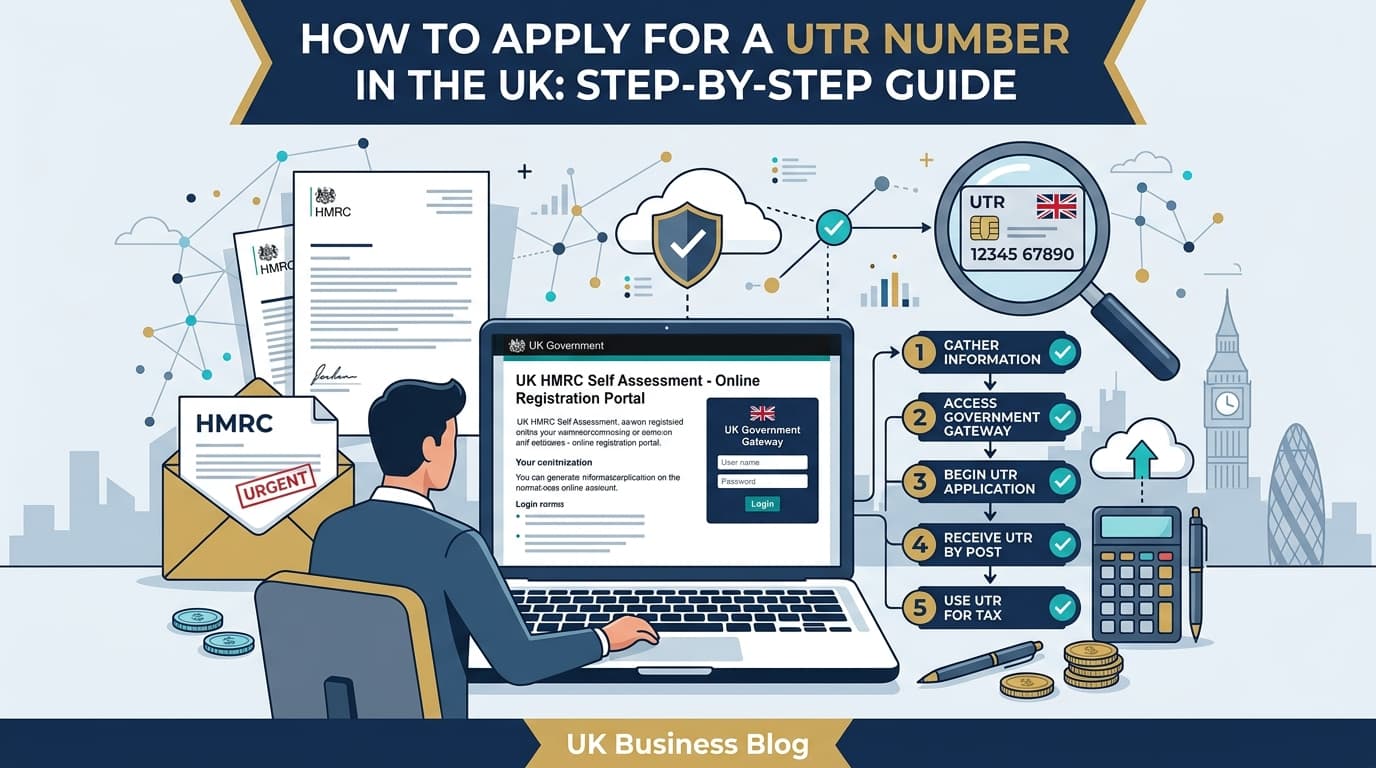
You don't apply for a UTR number on its own. If you're self-employed, a sole trader, or a partner in a partnership, you get a Unique Taxpayer Reference automatically when you register for Self Assessment with HMRC, usually by post within about 10 working days (up to 21 if you're abroad). If you run a limited company, HMRC issues a separate Corporation Tax UTR shortly after you incorporate with Companies House. Either way, the number itself is 10 digits long and stays with you for life.
Need help with UK tax registration or compliance?
Speak to Leadforce AdvisorsWhat Is a UTR Number and How Do You Get One?
If you've searched for "how to apply for a UTR number," you've probably noticed something confusing: there's no standalone application form for a UTR on its own. That's because a UTR isn't something you request in isolation — it's issued automatically as a by-product of two other processes: registering for Self Assessment (for individuals) or setting up a limited company (for Corporation Tax).
This guide explains exactly how the process works for sole traders, freelancers, contractors, partnerships and limited companies, what information you'll need, how long it takes, and what to do if your UTR goes missing.
What Is a UTR Number Used For?
A Unique Taxpayer Reference, or UTR, is a 10-digit number HMRC uses to identify you (or your company) in its tax systems. Every UTR is unique to the taxpayer it belongs to, and it doesn't change if you stop and later restart self-employment, change your business name, or move address.
You'll need your UTR whenever you:
- File a Self Assessment tax return
- Make a payment towards Income Tax, Class 2 or Class 4 National Insurance
- Register for Making Tax Digital for Income Tax
- Authorise an accountant or agent to deal with HMRC on your behalf
- Contact HMRC about your Self Assessment or Corporation Tax affairs
Important distinction: Individuals get a personal UTR through Self Assessment registration, while limited companies get a separate Corporation Tax UTR after incorporation. A director of a limited company may end up needing both — a personal UTR (if they also need to file a personal Self Assessment return) and the company's own UTR for Corporation Tax.
UTR Number vs Other Reference Numbers
It's easy to confuse a UTR with other numbers you'll come across when setting up in business. Here's how they differ:
| Reference | Issued by | Used for | Format |
|---|---|---|---|
| UTR (Unique Taxpayer Reference) | HMRC | Self Assessment and/or Corporation Tax | 10 digits |
| National Insurance number | DWP / HMRC | Tracking NI contributions and state benefits | 2 letters, 6 digits, 1 letter |
| Company Registration Number (CRN) | Companies House | Identifying an incorporated company | 8 digits (or 2 letters + 6 digits) |
| VAT number | HMRC | VAT-registered businesses | 9 digits, usually prefixed "GB" |
A UTR and a National Insurance number are not interchangeable, even though both may be requested on the same HMRC form. A Company Registration Number identifies your company at Companies House; your Corporation Tax UTR identifies the same company to HMRC. You may need to quote both, but they serve different purposes and come from different bodies.
Who Needs a UTR Number?
You'll usually need a UTR if you:
If you're only employed under PAYE with no other untaxed income, you generally won't need a UTR at all.
Do You Need a UTR Number?
Not everyone who earns money or runs a business in the UK needs a UTR number. You will generally need one when you have a tax obligation that requires you to register for Self Assessment, or when a company needs to deal with Corporation Tax.
You may need a personal UTR if you are self-employed, receive certain types of untaxed income, or have another reason to submit a Self Assessment tax return. A limited company has its own Corporation Tax UTR, which is separate from the personal UTR of its directors or shareholders.
If you are unsure whether you need to register for Self Assessment, you can check your circumstances with HMRC before starting the registration process.
How to Get a UTR Number: Step-by-Step
For Sole Traders, Freelancers and Contractors
- 1Check whether you actually need to register:
HMRC provides a "Check if you need to send a Self Assessment tax return" tool on GOV.UK. Use it if you're unsure.
- 2Register for Self Assessment online with HMRC:
You'll need a Government Gateway account. If you don't already have one, you can create one during registration.
- 3Complete the registration form:
Provide your personal details, National Insurance number, business details (if self-employed), and the date your untaxed income or self-employment started.
- 4Wait for HMRC to process your registration and post your UTR:
This typically arrives within about 10 working days for UK addresses, or around 21 working days if you're registering from overseas.
- 5Keep the letter safe:
It also confirms your Government Gateway details for filing online.
For Partnerships
Partnerships need to register the partnership itself for a partnership UTR, and each individual partner also needs their own personal UTR if they don't already have one. This is a common area of confusion — one UTR for the partnership does not cover the partners individually.
For Limited Companies
You don't apply for a Corporation Tax UTR separately. When you incorporate a company with Companies House, HMRC is notified automatically and sets up a Corporation Tax record for the business. The company's UTR is then posted to the registered office address, usually within a matter of days to a few weeks of incorporation. If a director also needs to file a personal Self Assessment return (for example, because of dividend income not covered by PAYE), they'll need to register separately for their own personal UTR too.
Information You'll Need Before You Start
Having the following ready will make the registration process smoother:
Types of UTR Numbers in the UK
The term UTR can refer to different tax references depending on the taxpayer. Understanding which UTR applies to you can help prevent mistakes when dealing with HMRC.
Personal UTR
Issued to an individual who registers for Self Assessment and used to identify their personal tax record.
Partnership UTR
Issued to a registered partnership for its partnership tax obligations. Individual partners also have personal UTRs.
Corporation Tax UTR
Issued to a limited company for Corporation Tax. It belongs to the company rather than individual directors.
A personal UTR and a company's Corporation Tax UTR are separate. If you are a company director who also has a personal requirement to file Self Assessment, you may therefore have both a personal UTR and a company UTR.
When Do You Need to Register for Self Assessment?
If you're registering for Self Assessment for the first time, HMRC's current guidance sets the notification deadline as 5 October following the end of the tax year in which you need to file. For example, if you need to file a Self Assessment return for the 2025–26 tax year, HMRC's guidance states that you generally need to notify HMRC by 5 October 2026.
Missing this deadline doesn't mean you can't register — HMRC will still process late registrations — but it does compress the time you have left before the 31 January online filing deadline, and it can lead to a failure-to-notify penalty if tax is owed and there's no reasonable excuse for the delay. It's worth registering as early as possible once you know you'll need to file, rather than waiting until close to either deadline.
How Long Does It Take to Get a UTR Number?
For individuals registering for Self Assessment, HMRC generally issues a UTR by post within around 10 working days of processing a UK-based registration, and around 21 working days for registrations from abroad. For companies, the Corporation Tax UTR is typically posted to the registered office not long after incorporation is confirmed.
Because the UTR arrives by post rather than instantly online, it's sensible to build this waiting time into your planning — particularly if you're registering close to either the 5 October notification deadline or the 31 January filing deadline.
What If Your UTR Has Not Arrived?
If you have registered for Self Assessment but your UTR has not arrived, there is usually no need to submit another registration. First, check whether your UTR is already available through your HMRC online account or existing tax correspondence.
If you still cannot find it after allowing sufficient time for HMRC to process your registration, contact HMRC using the appropriate Self Assessment contact channel. You may need to provide information to confirm your identity before HMRC can discuss your tax record.
⚠️ Do not create a second Self Assessment registration simply because your UTR letter has been delayed. Duplicate registrations can cause unnecessary confusion and may require HMRC to correct your records.
UTR Numbers for Non-UK Residents
Living outside the UK does not automatically mean that you need a UK UTR. However, an overseas individual may need one if they have UK tax obligations that require Self Assessment registration.
For example, a non-UK resident with relevant UK income or other circumstances requiring a UK tax return may need to register for Self Assessment and obtain a personal UTR. Similarly, an overseas founder or director of a UK limited company should distinguish between their personal tax position and the company's Corporation Tax obligations.
The company's Corporation Tax UTR belongs to the UK company and is separate from any personal UTR held by its directors. Non-UK residents should consider their individual circumstances and UK tax obligations before registering.
Where to Find Your UTR Number
If you've registered before, your UTR will appear on:
- The original HMRC welcome letter sent after registration
- Any notice to file a tax return
- Payment reminders and statements of account from HMRC
- Previous Self Assessment tax returns
- Your Personal Tax Account or the HMRC app, once logged in with your Government Gateway details
Lost UTR Number: What to Do
If you can't find any paperwork, log in to your Personal Tax Account or the HMRC app using your existing Government Gateway credentials — your UTR is displayed there. If you don't have online access set up, or you'd rather not use it, you can contact the Self Assessment helpline, though you'll need to answer identity verification questions such as your name, date of birth, National Insurance number and address. HMRC will not disclose your UTR by email for security reasons, and if you already have one, you should never register again from scratch, as this can create duplicate records and delays.
Sole Trader vs Limited Company: How the UTR Differs
| Feature | Sole Trader | Limited Company |
|---|---|---|
| How UTR is obtained | Automatically via Self Assessment registration | Automatically via Companies House incorporation |
| Who it identifies | You, personally | The company as a separate legal entity |
| Used for | Self Assessment tax return, personal tax payments | Corporation Tax return and payments |
| Do directors also need a personal UTR? | N/A | Only if they have untaxed personal income requiring Self Assessment |
| Deadline to notify HMRC | 5 October following the relevant tax year | No separate notification needed — triggered by incorporation |
What Happens After You Receive Your UTR?
Receiving your UTR is only one part of managing your UK tax obligations. Once you have your UTR, you should:
Your UTR identifies your tax record, but having a UTR does not by itself mean that a tax return is automatically due every year. Your filing obligations depend on your circumstances and HMRC requirements.
Common Mistakes to Avoid
Assuming a UTR is something you request on its own
It's issued through registration, not a standalone application.
Registering twice
Doing this because a previous UTR was misplaced creates duplicate records, rather than retrieving the existing one.
Leaving registration until close to 31 January
Finding out too late that the postal UTR hasn't arrived in time to file before the penalty deadline.
Confusing a personal UTR with a company UTR
Directors mistakenly submitting company returns with personal references or vice-versa.
Sharing a UTR insecurely
Treat it with the same care as other sensitive financial details, since it's used to identify you to HMRC.
Frequently Asked Questions
Q:Do I apply for a UTR number, or is it issued automatically?
It's issued automatically. You register for Self Assessment (as an individual) or incorporate a company (for Corporation Tax), and HMRC generates the UTR as part of that process.
Q:Can I get a UTR number the same day?
No. HMRC posts UTRs rather than issuing them instantly online, so you should expect to wait roughly 10 working days for a UK address, or longer if you're abroad.
Q:Is a UTR the same as a National Insurance number?
No. Your National Insurance number relates to state benefits and contributions, while your UTR identifies you for tax purposes with HMRC. You'll often need to provide both, but they aren't interchangeable.
Q:What if I need a UTR for a limited company?
You don't apply separately. Once your company is incorporated with Companies House, HMRC automatically sets up a Corporation Tax record and posts the UTR to your registered office address.
Q:How do I find a UTR I've lost?
Check your Personal Tax Account, the HMRC app, or previous HMRC correspondence such as tax return notices and payment reminders. If none of these help, contact the Self Assessment helpline directly.
Q:What happens if I register after the 5 October deadline?
HMRC can still process your registration, but you may face a failure-to-notify penalty if tax is owed and there's no reasonable excuse, and you risk running short of time before the 31 January filing deadline.
Q:Does a UTR number ever expire or change?
No. Once issued, your UTR is permanent and stays the same regardless of changes to your employment status, business structure, or address.
How Leadforce Can Help
Registering for Self Assessment or incorporating a company correctly the first time makes a real difference to how smoothly your tax affairs run afterwards. Leadforce works with UK and overseas founders, sole traders and company directors to get registrations set up properly, ensure the right UTRs are in place for both personal and company obligations, and keep track of key HMRC deadlines so nothing is missed. If you're setting up a new business structure or aren't sure which UTR applies to your situation, it helps to get this right from the outset rather than untangling it later.
If you need guidance on registering for Self Assessment, setting up a limited company, or understanding which UTR applies to your circumstances, the Leadforce team can help you understand your options and the relevant requirements.