
 Whatsapp
UK VAT Registration Threshold: When Must You Register?
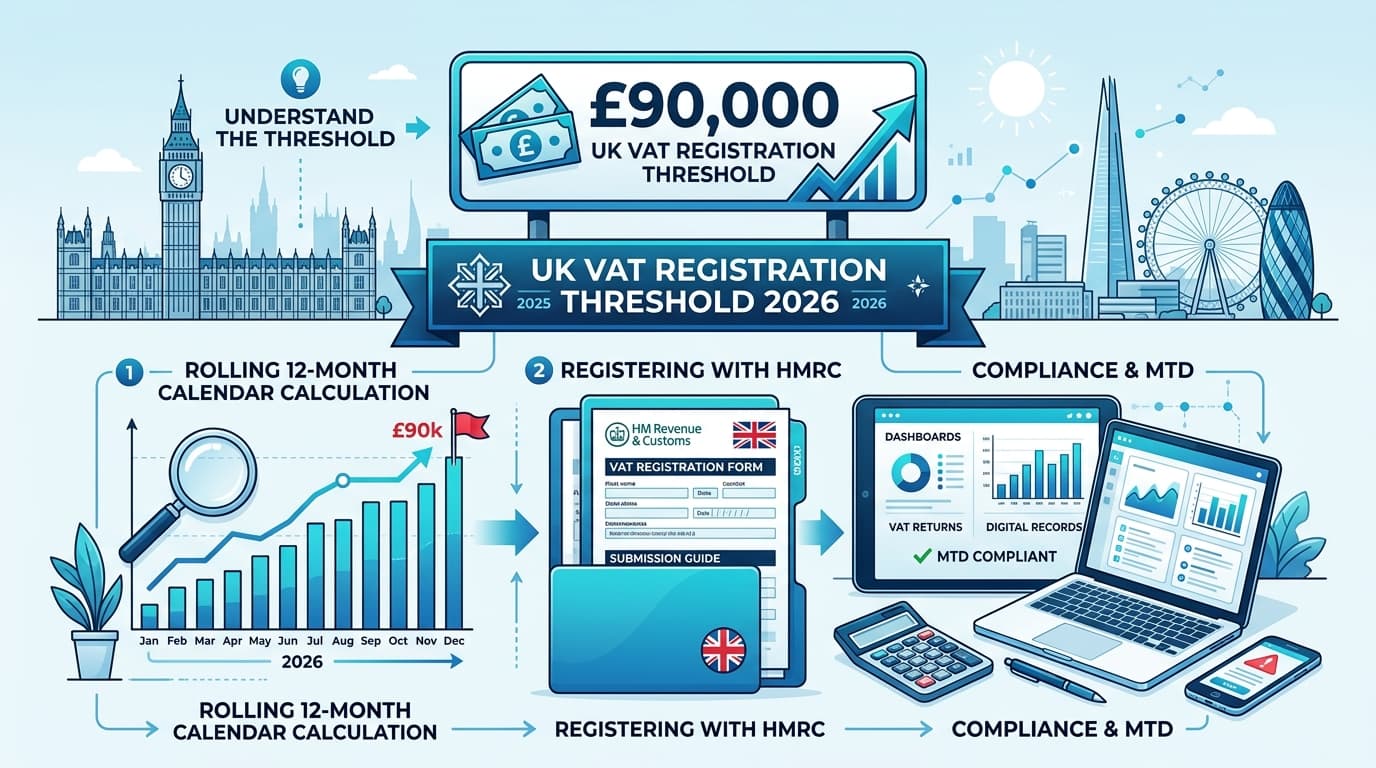
If your business is growing, there's one number worth knowing off the top of your head: £90,000. That's the current UK VAT registration threshold, and once your taxable turnover crosses it, registering with HMRC stops being a choice and becomes a legal obligation. The tricky part isn't the figure itself — it's knowing exactly when you've crossed it, because HMRC doesn't measure this against your accounting year or the tax year. It measures it against a rolling 12-month window that moves every single month.
This guide explains what the threshold is, how the rolling 12-month and forward-look tests work, what counts towards your taxable turnover, what happens if you register late, and when voluntary registration might work in your favour.
If you need help determining whether your business must register for VAT, Leadforce’s UK VAT registration services can support you through the registration process and related compliance requirements.
Quick Answer
The UK VAT registration threshold is £90,000 of taxable turnover in any rolling 12-month period, not just your financial year. If your turnover goes over £90,000 at the end of any month, you must notify HMRC within 30 days, and your VAT registration takes effect from the first day of the second month after you crossed the threshold. You must also register immediately if you expect to exceed £90,000 in the next 30 days alone. The deregistration threshold is £88,000.
What Is the VAT Registration Threshold
The VAT registration threshold is the level of taxable turnover at which a business becomes legally required to register for VAT with HMRC. It has stood at £90,000 since 1 April 2024, when it rose from £85,000, and the government confirmed the figure would remain frozen afterwards. It continues to apply at £90,000 for the 2026/27 period.
This threshold applies to any UK business — sole trader, partnership, limited company, or overseas business supplying goods or services into the UK — regardless of size, sector or structure. What matters is taxable turnover, not profit, and not simply what lands in your bank account.
What Counts as Taxable Turnover
Taxable turnover is the total value of everything you sell that isn't exempt from VAT. This includes:
Zero-rated sales still count towards your £90,000 threshold, even though no VAT is actually charged on them. This surprises a lot of business owners who assume that because no VAT changes hands, the sale doesn't matter for registration purposes. It does.
What doesn't count is VAT-exempt turnover — certain insurance, financial services, and some property transactions, for example. Getting this distinction right at the outset makes the rest of the calculation far easier.
The Rolling 12-Month Rule
This is where most businesses get caught out. HMRC doesn't check your turnover against your financial year or the tax year. It checks it against a continuous 12-month period that rolls forward every month.
In practice, that means at the end of each month, you add that month's turnover to your running total and drop the oldest month off the other end. If, at the end of any month, your rolling total exceeds £90,000, you must notify HMRC within 30 days of the end of that month.
Example: Furniture Business Calculation
A furniture business finds that its taxable turnover for the 12 months ending 31 August comes to £91,500. It must notify HMRC by 30 September. Its effective date of registration is 1 October — the first day of the second month after the threshold was breached. From that date, it must charge VAT on its taxable sales, whether or not HMRC has issued the VAT number yet.
The rolling nature of the test means a business can be well under the threshold in January and over it by June, simply because of a few strong months of trading. Checking turnover monthly, rather than annually, is the only reliable way to catch a breach in good time.
The Forward-Look Test
Alongside the rolling 12-month test, there's a second, less well-known rule: the forward-look test. If, at any point, you have reasonable grounds to believe your taxable turnover will exceed £90,000 in the next 30 days alone, you must register immediately — not within 30 days, but straight away.
This typically catches businesses that land a single large contract or a significant one-off order. If signing that contract would take your taxable supplies in the next month past £90,000, the forward-look test applies from the moment you have reasonable grounds to expect it, not from the moment the money arrives.
Businesses expecting a large contract or a seasonal spike that could push turnover sharply upward should check this test before committing, rather than after.
How and When to Register for VAT
Once you know that your business has crossed the VAT registration threshold under either the previous 12-month test or the next 30-day test, you need to notify HMRC within the applicable deadline.
1Register with HMRC
Most businesses can register online through their Government Gateway account on GOV.UK. If your taxable turnover exceeded £90,000 based on the previous 12 months, you generally have 30 days from the end of the month in which you exceeded the threshold to register. If you expect to exceed £90,000 in the next 30 days, you must register within 30 days of the date you realised this would happen.
2Provide your business details
Depending on your business structure, you may need to provide information such as your company registration number, UTR, bank details, annual turnover and estimated taxable turnover for the next 12 months.
3Receive your VAT registration details
HMRC will confirm your 9-digit VAT registration number, your effective date of registration and information about submitting your first VAT Return.
4Account for VAT from your effective date
Your VAT obligations begin from your effective registration date. However, you cannot show VAT on invoices until you have received your VAT registration number. If your effective date has already passed, you may need to account for VAT on sales made from that date and adjust or reissue invoices once your VAT number is available.
5Choose an appropriate VAT accounting scheme
Depending on your circumstances and eligibility, you may be able to use schemes such as Standard VAT Accounting, Cash Accounting or the Flat Rate Scheme. Each has different eligibility requirements and ways of calculating or reporting VAT.
What Happens If You Register Late
Missing the notification deadline triggers HMRC's failure to notify the penalty regime. The penalty is calculated as a percentage of the VAT that should have been paid between your effective registration date and the date HMRC either received your notification or became aware you should have registered. Penalty rates depend on how late the registration is and the taxpayer's behaviour, and can run from a lower percentage for an honest, quickly disclosed oversight up to a substantially higher rate for deliberate or prolonged non-compliance.
Financial Risk: On top of any penalty, you'll also owe the VAT itself for the period you should have been registered, plus interest. This is one of the more painful aspects of late registration: if you didn't add VAT to your prices during that period, you may have to find the 20% out of your own margin rather than passing it on to customers after the fact.
The safest approach is a genuine monthly check of rolling turnover, so any breach is caught within days rather than months.
Voluntary VAT Registration
You don't have to wait until you hit £90,000. Businesses can register voluntarily at any turnover level, and for some, it's a smart move rather than an unwanted obligation.
Voluntary registration tends to make sense when:
It tends to make less sense when your customers are mainly the general public or VAT-exempt businesses, since adding 20% to your prices could make you less competitive without any offsetting benefit to the customer.
The Deregistration Threshold
Alongside the registration threshold sits a separate deregistration threshold, currently £88,000. If your taxable turnover for the next 12 months is expected to fall below this figure, you can apply to deregister voluntarily. Deregistration isn't automatic — you need to notify HMRC and satisfy them that your turnover genuinely won't cross the deregistration threshold going forward.
Sole Traders, Partnerships and Limited Companies
The £90,000 threshold applies in exactly the same way regardless of business structure. There's no separate, more generous limit for sole traders, and no reduced threshold for limited companies. What changes between structures is less the threshold itself and more the practical impact of registering.
| Feature | Sole Trader / Partnership | Limited Company |
|---|---|---|
| Threshold that applies | £90,000 rolling 12 months | £90,000 rolling 12 months |
| Registration process | Same GOV.UK process, personal Government Gateway account | Same GOV.UK process, company Government Gateway account |
| Impact on pricing | Directly affects sole trader's own margin if VAT not passed on | Affects company pricing and invoicing across all customers |
| Record-keeping burden | VAT records alongside self-assessment records | VAT records alongside statutory company accounts |
| Suitable for | Freelancers, contractors, small consultancies | Growing businesses trading with VAT-registered B2B customers |
Common Mistakes to Avoid
Checking turnover against the tax year instead of a rolling 12 months
The rolling test moves every month; an annual-only check can miss a mid-year breach entirely.
Assuming zero-rated sales don't count
They do — only exempt sales are excluded from taxable turnover.
Ignoring the forward-look test
A single large contract can trigger an immediate registration requirement, not a 30-day one.
Waiting for the VAT number before charging VAT
Your liability starts from the effective registration date, regardless of when the number arrives.
Treating registration as optional once turnover has clearly exceeded the threshold
At that point, it's compulsory, not a choice.
Frequently Asked Questions
What is the current UK VAT registration threshold?
The threshold is £90,000 of taxable turnover in any rolling 12-month period. It has applied since 1 April 2024 and remains at £90,000.
Is the VAT threshold based on my financial year?
No. HMRC uses a rolling 12-month period ending in the current month, not your accounting or tax year. You need to check your turnover regularly, ideally monthly.
Do zero-rated sales count towards the £90,000 threshold?
Yes. Zero-rated sales are still taxable supplies for threshold purposes, even though no VAT is charged on them. Only VAT-exempt sales are excluded.
What happens if I don't register for VAT on time?
You may face a failure to notify penalty based on the VAT that should have been paid, plus the VAT itself and interest, backdated to your effective registration date.
Can I register for VAT before I reach £90,000?
Yes. Voluntary registration is available at any turnover level and can be beneficial if your customers are mainly VAT-registered businesses or you want to reclaim VAT on purchases.
What is the deregistration threshold?
The deregistration threshold is £88,000. If your expected turnover for the next 12 months falls below this, you can apply to deregister.
How quickly must I register once I cross the threshold?
You have 30 days from the end of the month in which you crossed £90,000 to notify HMRC, unless the forward-look test applies, in which case you must register immediately.
Does the VAT threshold differ for sole traders and limited companies?
No. The £90,000 threshold applies equally regardless of business structure.
How Leadforce Can Help
Working out exactly when your rolling 12-month turnover crosses £90,000 — and getting the registration, effective date and VAT scheme right from day one — is easy to get wrong when you're focused on running the business itself. Leadforce supports UK sole traders, limited companies and international founders with VAT registration, ongoing VAT compliance, and the wider company formation and tax obligations that come with growth. Whether you're approaching the threshold, considering voluntary registration, or need to correct a late registration, our team can talk you through the practical steps involved.
If you need guidance on the VAT registration threshold, the Leadforce team can help you understand your options and the relevant requirements.